
TL;DR: Character AI App Development Cost
- Building an app like Character AI can cost $25,000 to $50,000 for a basic MVP.
- Key cost factors include AI model integration, long-term memory, voice and multimodal features, scalability, platform coverage, and development expertise.
- Individual feature development can range from $2,000 to $30,000+, with real-time AI conversations and long-term memory among the more expensive components.
- Monthly operating expenses cover AI API usage, GPU infrastructure, hosting, storage, moderation, maintenance, and customer support. Actual costs depend on usage and service requirements.
Building an app like Character AI involves more than developing a chatbot. It requires an interactive experience where users can connect with virtual characters, engage in natural conversations, and maintain continuity across interactions. Delivering this experience involves several interconnected components, from AI model integration and character customization to conversation management and data storage.
The development budget depends on how these components are designed and implemented. Using third-party AI services, developing custom models, adding advanced memory capabilities, and supporting multiple platforms all bring different technical requirements and levels of effort.
This guide breaks down the cost of developing an app like Character AI, covering individual feature estimates, the factors that influence the overall budget, and the ongoing expenses after launch. It also explains how businesses can manage their initial investment while building a platform that can grow with their requirements.
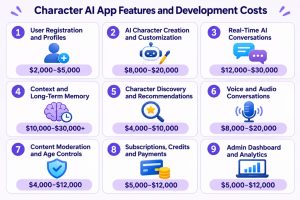
Character AI App Features and Their Development Costs
The features cover the core components needed to build an AI character app, from character creation to conversation management and user accounts. Each feature has a separate development estimate based on its implementation requirements.
1. User Registration and Profiles
Estimated development cost: $2,000-$5,000
User registration and profiles cover registration, account verification, password recovery, and editable profiles. Each account must also have access to its own conversations, saved characters, and preferences.
Development includes managing expired sessions and failed sign-in attempts. Supporting both email and social login requires additional account-linking logic. Age-verification workflows are covered separately under content moderation and age controls.
2. AI Character Creation and Customization
Estimated development cost: $8000-$20,000
A character builder lets users define a character’s name, greeting, personality, background, and conversational style. These settings guide how the AI generates responses.
The development scope includes creating, editing, saving, and publishing characters, along with public and private visibility settings. A preview chat lets users test a character before publishing. Testing also checks whether changes to a character’s settings are applied correctly to new conversations.
3. Real-Time AI Conversations
Estimated development cost: $12,000-$30,000
This feature connects the chat interface to a language model and displays its responses as they are generated. Development includes message history, switching between conversations, stopping an ongoing response, and requesting another answer.
The system must also handle interrupted requests and failed responses. For example, when a user retries a failed message, the app should avoid creating duplicate entries. The estimate depends on the model integration, supported chat controls, and response-handling requirements.
4. Context and Long-Term Memory
Estimated development cost: $10,000-$30,000+
Long-term memory allows an AI character to retain selected details across conversations. For example, a character might remember a user’s preferred name or an important detail from an ongoing roleplay.
The memory architecture for AI companion apps involves selecting, storing, and retrieving relevant information when a conversation resumes. Development may also include updating or deleting stored memories, allowing users to correct information and ensuring that each account’s memories remain separate.
5. Character Discovery and Recommendations
Estimated development cost: $4000-$10,000
A discovery system helps users find characters through keyword search, categories, filters, featured listings, and sorting options. Development includes character indexing, search results, pagination, and visibility rules to prevent private characters from appearing in public listings.
Personalized recommendations require additional work, including activity tracking and ranking logic. The estimate should distinguish a searchable character catalog from a recommendation system that adapts suggestions to individual users.
6. Voice and Audio Conversations
Estimated development cost: $8,000-$20,000
Voice functionality can convert a character’s text responses into audio. A basic implementation may include voice selection, audio playback controls, and handling for failed audio generation.
Live voice conversations require additional components, such as microphone access, speech recognition, turn-taking, interruption handling, and session recovery when a connection drops. The development quote should distinguish generated audio messages from live voice calls because their integration and testing requirements differ.
7. Content Moderation and Age Controls
Estimated development cost: $4000-$12,000 for content moderation
Content moderation tools cover integrating content-checking services, applying platform rules, handling user reports, and sending flagged interactions for review. They also define how the app responds when content is blocked or a moderation check fails.
For platforms that support adult-oriented characters, NSFW content controls and age-gating may require an additional $ 6,000- $15,000. This scope can include age-assurance services, content classification, restricted character visibility, user consent controls, and region-specific access rules. The final estimate should account for any development work shared between the moderation and age-control systems to avoid double-counting.
8. Subscriptions, Credits and Payments
Estimated development cost: $5,000-$12,000
A monetization system connects user payments to subscription access and usage allowances. Combining subscriptions with usage-based credits requires subscription management, credit balances, purchase records, and deductions for chargeable actions.
Testing ensures that repeated payment notifications do not add credits more than once and that subscription changes update user access correctly. The system should also define how credits are handled when an AI request fails or is canceled.
9. Admin Dashboard and Analytics
Estimated development cost: $5,000-$12,000
An admin dashboard gives platform operators a central place to manage user accounts, characters, subscription plans, and reported content. Basic analytics can track active users, conversation volume, subscription revenue, credit usage, and failed AI requests.
Development also includes user permissions and records of important administrative actions. The dashboard should use data from the payment and moderation systems already built into the platform. Custom reports, advanced analytics, and detailed financial reconciliation can increase the development cost.
Factors That Affect Character AI App Development Cost
The development budget is shaped by several factors beyond the features included in the initial plan. Technical complexity, project timelines, and expected performance all influence the overall investment.
1. Third-Party LLM APIs vs Custom AI Models
Using a hosted large language model (LLM) API concentrates development on connecting the model to the application and evaluating its responses. The provider manages the underlying model infrastructure.
Fine-tuning an existing model adds dataset preparation, training experiments, and validation. Training a model from scratch involves a much larger research and engineering scope. These approaches need separate estimates because custom AI development can involve very different levels of work.
2. Text-Based vs Multimodal AI Features
Supporting text, images, and audio increases the work needed to coordinate different AI services. A conversation that moves between these formats must retain its context while handling each service’s processing requirements.
Testing must cover different input and output combinations, including transitions between text, images, and audio. This integration work can make a combined experience more expensive than separate, independently functioning tools.
3. Web, iOS and Android Development
Platform coverage determines how many environments the development team must build, test, and release. A web app requires a browser-based interface, while native iOS and Android apps need separate platform-specific development and testing.
The frontend technology choices for an AI companion app influence how much implementation can be shared across web and mobile. Cross-platform frameworks can reduce duplicated code, but device testing, operating-system differences, app store submissions, and release management still require time. A responsive website therefore has a different delivery scope from a product that includes published iOS and Android applications.
4. Scalability and Performance Requirements
Performance requirements become clearer when expressed as peak simultaneous conversations, acceptable response delays, and recovery expectations. Registered-user totals alone do not describe the workload an application must handle.
Building an AI companion platform can involve load testing, request prioritization, caching, and distributing traffic across servers. Stricter availability and response-time targets increase the engineering and validation work required before launch.
5. Development Team and Expertise
The final development cost reflects both the team’s rates and the time required to deliver the agreed scope. A lower hourly rate does not necessarily mean a lower project cost if the work requires extensive investigation, coordination, or rework.
When comparing AI companion app development companies, relevant project experience helps businesses assess the proposed budget. Development proposals should specify who handles AI integration, application development, testing, and deployment, including any specialist work priced separately.
6. Data Privacy, Security and Compliance
Launch markets and data-handling requirements can affect provider selection, infrastructure design and release preparation. Requirements to process information in particular regions, for example, may narrow the available hosting and AI-service options.
The budget also depends on the assurance work expected before launch, such as security testing, documentation, and independent assessments. Defining these requirements early allows them to shape the architecture and delivery plan, reducing the likelihood of expensive changes near release.
Ongoing Costs of Running an App Like Character AI
After launch, operating costs depend on user activity, AI usage, and the services needed to keep the platform running. The following figures are indicative monthly estimates. Some providers bundle multiple services, so avoid counting the same expense twice.
1. AI API and Model Inference
Estimated monthly cost: $500-$15,000+ for LLM API usage
LLM API costs depend on the volume of text processed and generated. Conversation volume, average response length, and the amount of previous chat history sent with each request all affect monthly usage.
Platforms using self-hosted or dedicated model inference may also spend $1000-$20,000+ per month on GPU infrastructure. These expenses apply alongside API costs only when the platform uses both approaches.
2. Hosting, Storage and Database
Estimated monthly cost: $500-$10,000+ for cloud hosting and content delivery
Conversation storage can add $100-$2,000+ per month, while a separately billed vector database may cost another $50-$3,000+.
The volume of stored conversations and media affects storage requirements. Database queries, backups, and outbound data transfer also contribute to monthly expenses. Check which resources are included in the hosting plan before adding separate estimates.
3. Voice and Image Generation
Estimated monthly cost: $200-$10,000+ for speech recognition and voice generation $200-$10,000+ for image generation
Voice and image generation costs depend on the services used and their billing models. Audio duration, image volume, output settings, and provider pricing determine the monthly spend. Forecast each service separately based on expected usage.
4. Content Moderation
Estimated monthly cost: $200-$5,000+
Content moderation costs depend on the provider’s billing method. Services may charge by API request, text volume, number of images, or audio duration. The monthly forecast should include checks on both user messages and AI-generated responses.
Human review can add staffing costs when flagged content requires manual assessment and moderation.
5. Maintenance and Customer Support
Estimated monthly cost: $1000-$8,000+ for maintenance and $500-$5,000+ for customer support
Maintenance covers bug fixes, security updates, and compatibility changes. Customer support costs depend on ticket volume, service hours, and the assistance users need with accounts, subscriptions, and purchases.
Monitoring and analytics can add $100-$2,000+ per month, while model evaluation and prompt updates may require another $ 300-$5,000+. Include these as separate budget items only when they are not already covered by the maintenance agreement.
How to Reduce Character AI App Development Costs
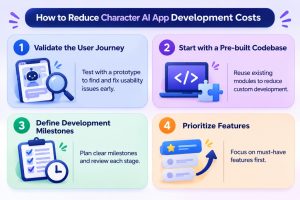
Businesses can reduce Character AI app development costs by defining the initial scope, reusing suitable software components, and controlling development changes.
Validate the user journey with an interactive prototype
A clickable prototype helps identify usability problems before they require expensive development changes. Testing the main user journey with a small group can reveal confusing navigation, unclear purchase options, and unnecessary steps. Resolving these issues during prototyping costs less than redesigning completed screens or modifying connected components later.
Start with a pre-built codebase
A pre-built codebase with reusable modules for user accounts, subscriptions, payments, and admin management can reduce the amount of custom development required. Compare its existing functionality with the Character AI app requirements and identify the components that need modification or additional development. Include UI customization, API integrations, and backend changes in the estimate. The savings depend on how much of the codebase can be used without extensive re-engineering.
Define development milestones and acceptance criteria
Each milestone should specify its deliverables, review process, and completion criteria. Consolidating feedback through one decision-maker gives developers consistent direction and prevents conflicting requests from creating additional work. Assess the cost and timeline impact of change requests before adding them to the development scope.
Prioritize features across development phases
Keep non-essential features in a separate product backlog rather than including everything in the initial release. After launch, user behavior and support feedback can help determine which additions deserve investment. This approach directs development resources towards features with demonstrated demand instead of increasing the initial budget with unvalidated requirements.
Final Thoughts
The development budget should support an AI character experience that gives users a reason to return. Spending decisions become clearer when the product has a defined audience and a realistic path to revenue.
Fanso’s customizable AI companion software gives businesses a ready-made foundation to build on. Talk with our team to identify the changes your platform needs and get a development estimate for your launch.
FAQs About the Development Cost of a Character AI App
1. How much does it cost to build an AI character chatbot?
Building an AI character chatbot can cost around $25,00 to $50,000 for a basic MVP. This typically includes user accounts, AI character creation, text chat, basic profiles, moderation, and an admin panel. More advanced features, such as long-term memory, voice conversations, and personalized recommendations, increase the development budget.
2. How long does it take to develop an app like Character AI?
A basic MVP may take around 3-5 months to develop. The timeline depends on the features included, AI integration requirements, platform coverage, and testing scope. Adding native mobile apps, multimodal capabilities, or advanced memory systems can extend the development period.
3. Can I build a Character AI-like app using a clone script?
Yes. A clone script can provide reusable components for features such as user accounts, subscriptions, payments, and admin management. The codebase may still need UI customization, AI integrations, and backend changes to support character creation, conversations, and memory. The final cost depends on how much of the existing software can be reused without extensive re-engineering.