
TL;DR: Content Moderation Tools for AI Companion Platforms
- AI companion platforms need moderation across prompts, AI responses, conversation history, roleplay, personal data, and generated media.
- Multi-turn conversations create risks such as emotional dependency, self-harm, sexual content, violence, privacy violations, and jailbreak attempts that basic keyword filters can miss.
- Tool selection depends on the platform’s needs, with options ranging from multimodal moderation and AI safety to policy management, security controls, and human review.
- Hive Moderation, Sightengine, OpenAI, and Azure AI Content Safety support content detection, while Alice WonderFence, Checkstep, Lasso Moderation, and WebPurify add security, workflow, language, or human-review capabilities.
- A strong moderation setup uses multiple checkpoints before and after AI generation, plus conversation-level monitoring and human escalation for high-risk or uncertain cases.
AI companion platforms require moderation beyond individual chat messages. User prompts, AI-generated responses, conversation history, roleplay, personal data, and generated media can each introduce different safety risks.
For example, a user might submit a harmful request, an AI response could introduce unsafe content, or a conversation could gradually shift toward self-harm, sexual content, threats, or other dangerous activities. Images, videos, audio, and uploaded files create additional moderation challenges.
Keyword filtering alone is not enough for these environments. Effective moderation should evaluate user inputs, AI outputs, conversation context, media, and attempts to bypass safety controls.
This guide covers the main moderation challenges, what to evaluate when selecting a moderation tool, eight tools worth considering, and how to build a layered moderation pipeline.
Understanding AI Companion-Specific Moderation Challenges
AI companion platforms create moderation challenges that do not always appear in traditional social networks or standalone chat applications. Interactions can continue across multiple sessions, involve personalized AI characters, include roleplay and media generation, and change direction as a conversation develops.
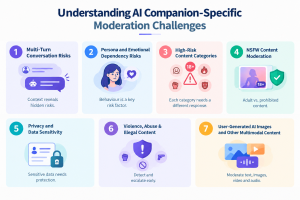
A moderation strategy needs to consider both the content being exchanged and the context in which it appears.
Multi-Turn Conversation Risks
Risk can develop across multiple messages rather than appearing in a single prompt. A conversation may move from emotional distress to self-harm, sexual content, threats, or dangerous instructions.
Moderation systems require relevant conversation history, previous violations, and changes in user intent instead of evaluating every message in isolation.
Persona and Emotional Dependency Risks
AI companions maintain ongoing personal interactions, which can create risks that standard keyword filters may miss. An AI character could encourage isolation, claim to be the user’s only source of support, use guilt or threats, or reinforce harmful beliefs.
Platform policies need to address manipulation, coercion, emotional dependency, and attempts by the AI to discourage users from seeking human support.
High-Risk Content Categories
Building an AI companion platform may encounter several high-risk content categories, including:
- Self-harm and suicide
- Sexual and explicit content
- Sexual content involving minors
- Violence, threats, abuse, and exploitation
- Dangerous or illegal activities
- Harassment, hate, fraud, and scams
The appropriate response varies by severity and context. Platform policies should define which content must be blocked, which situations require a safety response, and which cases are escalated for further review.
Privacy and Data Sensitivity
AI companion conversations may contain phone numbers, addresses, financial information, passwords, relationship details, workplace information, or other sensitive data.
Moderation systems account for how this information is detected, redacted, stored, and accessed. Businesses also decide whether to retain sensitive information in conversation history or reproduce it in future AI responses.
Violence, Abuse & Illegal Content
Violent or illegal content requires contextual analysis. A fictional fight within a roleplay scenario is different from instructions intended to harm a real person.
Moderation distinguishes between fictional scenarios, general discussion, expressions of intent, actionable instructions, and credible threats. The platform’s response has to reflect the level of risk identified.
AI-Generated Images and Other Multimodal Content
Risk can appear in uploaded media, generation prompts, AI-generated content, or text contained within visual content.
Platforms supporting images, video, or audio may need moderation at several points in the media workflow. Policies need to define which media types are restricted and which cases require additional review.
Jailbreaks and Prompt-Injection Attempts
Users may attempt to bypass safeguards by changing the model’s role, asking it to ignore system instructions, disguising restricted requests through roleplay, or modifying the wording of a request.
Treat these attempts as both a moderation and application-security concern because successful attacks can affect the model’s subsequent responses.
What Should You Look for in an AI Companion Moderation Tool?
Choosing a moderation provider requires more than comparing the number of categories an API can detect. The solution should fit the platform’s content types, safety policies, user base, traffic, privacy requirements, and technical architecture.
Businesses can evaluate the following capabilities before integrating a moderation provider.
Content and Media Types Supported
Start with the types of content the platform processes. A text-based companion may mainly require prompt and response moderation, while a multimodal product may also need controls for images, video, audio, and uploads.
Check whether the provider supports:
- Text
- Images
- Video
- Audio
- OCR
- Multimodal inputs
- Usernames and profile information
- URLs
If the platform supports several media types, determine whether one provider can cover the required content surfaces or whether multiple moderation services will be necessary.
Moderation Accuracy and False Positives
Moderation accuracy affects both platform safety and user experience. Excessive false positives can interrupt legitimate conversations, especially in AI companion environments where roleplay, slang, sarcasm, and sensitive discussions are common.
Look for confidence scores, severity levels, and category-specific signals. These outputs let the application apply different actions based on risk instead of treating every flagged interaction as a simple block-or-allow decision.
Custom Rules and Thresholds
Every AI companion platform operates under its own content policy. A general moderation model may detect sexual content, violence, or hate speech, but a platform may also need rules for minors, emotional dependency, roleplay, generated media, or repeated violations.
Custom categories, blocklists, thresholds, and policy rules help align moderation with the platform’s requirements. This is also important when businesses operate separate SFW and NSFW experiences or serve users across different jurisdictions.
Real-Time Moderation and Latency
AI companion interactions need to remain responsive. If moderation adds significant latency to every request, it can affect the conversation experience.
Evaluate API response times, rate limits, throughput, and performance under expected production traffic. A practical architecture can use fast automated checks for clear violations while sending ambiguous or high-risk cases through additional analysis or human review.
Multilingual Support
If the platform serves users across multiple markets, moderation accuracy needs to extend beyond English.
Evaluate the provider’s:
- Supported languages
- Accuracy across individual languages
- Mixed-language handling
- Slang detection
- Character substitutions
- Unicode and leetspeak detection
- Language identification
Strong English-language performance does not necessarily indicate equivalent performance across every language the platform supports.
Human Review Capabilities
Automated moderation cannot resolve every case. Some interactions require additional context or human judgment, especially when confidence is low or the potential consequences are significant.
Look for capabilities such as:
- Review queues
- Conversation context
- Case management
- Escalation workflows
- Appeals
- Moderation decision tracking
A structured review process can help moderation teams maintain consistent decisions as the platform grows.
Privacy and Data Handling
Moderation providers process conversations that may contain sensitive information. Evaluate data handling during vendor selection.
Review:
- Whether prompts and responses are stored
- Data retention periods
- Where data is processed
- Whether sensitive information can be redacted
- Who can access moderation records
- Whether retention settings can be configured
These considerations are important for platforms operating in regulated markets or processing sensitive conversations at scale.
Pricing and Scalability
Moderation costs can change significantly as an AI companion platform grows. A product processing thousands of messages each month has different requirements from one processing millions of conversations alongside generated images, video, and audio.
Compare whether the provider charges by API request, characters, tokens, images, video frames, audio duration, or another unit.
Also calculate the cost of moderating both sides of the interaction: the user’s input and the AI-generated response.
8 Top Content Moderation Tools for AI Companion Platforms
| Content Moderation Tool | Content Types | Key Capabilities | Best Use |
| Hive Moderation | Text, image, video, audio | Multimodal content detection and classification | AI companions with user-generated or AI-generated media |
| Sightengine | Text, image, Video | Content classification, OCR and visual moderation | Platform handling images, videos, and text with media |
| OpenAI Moderation API | Text, Image | Harmful-content detection with category scores | Moderating AI prompts and generated responses |
| Microsoft Azure AI Content Safety | Text, image | Harm detection, severity levels, jailbreak and prompt- injection detection | Businesses needing configurable AI safety controls |
| Alice WonderFence | AI inputs and outputs | Real-time guardrails, custom policies, PII detection, jailbreak projection | AI companion platform needing broader AI safety controls |
| Checkstep | Text, image, video | Automated moderation, human review, case management | Platforms requiring escalation and manual review |
| Lasso moderation | Text, image, video | Multilingual moderation and evasion detection | AI companions serving users across multiple languages |
| WebPurify | Text, image, video | Automated and human moderation | Business combining automated screening with human review |
1. Hive Moderation
Hive is a strong choice for platforms handling several content types. Its current moderation products cover text, images, video, and audio, with OCR capabilities for text appearing inside visual content.
Best fit: AI companions with image or video generation, user uploads, or voice interactions.
Limitation: A text-only companion may not need its full multimodal stack.
Pricing: Usage-based, starting around $0.50 per 1,000 text requests and $3 per 1,000 image requests; audio moderation is roughly $0.03 per minute, with custom enterprise pricing for higher volumes.
2. Sightengine
Sightengine provides moderation for text, images, video, live streams, OCR, and QR codes. Its visual moderation capabilities can also identify categories such as adult content, violence, weapons, self-harm, and other restricted content.
Best fit: Companion platforms where chat and visual content are part of the same product.
Limitation: It is primarily a content detection and filtering layer, so broader companion governance may require additional systems.
Pricing: Freemium with paid tiers; Starter at $29/month for 10,000 operations and $0.002 per additional operation, Pro at $99/month for 40,000 operations with advanced video and audio.
3. OpenAI Moderation API
The OpenAI Moderation API classifies text and image inputs and returns moderation categories, scores, and flags. It can therefore be placed around both user prompts and AI-generated responses.
Best fit: Startups looking for a straightforward text-and-image moderation layer.
Limitation: Don’t treat it as a complete Trust & Safety system. Conversation-level risk, account enforcement, persona rules, and human review still require additional handling.
Pricing: The Moderation endpoint is free for OpenAI API users, and moderation usage does not count toward the monthly API usage limits.
4. Microsoft Azure AI Content Safety
Azure AI Content Safety supports text and image moderation with severity levels, along with additional controls such as Prompt Shields for adversarial user inputs. Its current documentation also supports multimodal analysis and custom detection capabilities.
Best fit: Businesses that need configurable AI safety controls alongside content moderation.
Limitation: Teams that do not use Azure may have more infrastructure and integration work.
Pricing: The F0 tier includes 5,000 text records and 5,000 images per month at no charge. The S0 tier is pay-as-you-go, with billing based on text records and images; a text record contains up to 1,000 characters. Microsoft currently exposes the paid unit prices through its pricing calculator rather than showing a fixed public dollar amount on the pricing page.
5. Alice WonderFence
WonderFence is part of Alice’s broader AI safety platform and is designed to monitor AI inputs and outputs against safety, security, and privacy policies.
Best fit: AI companion businesses looking beyond basic harmful-content classification and needing controls around PII, data leakage, jailbreaks, prompt injection, and custom policies.
Limitation: Its broader enterprise capabilities may not be necessary for a small text-only product.
Pricing: Custom enterprise pricing.
6. Checkstep
Checkstep focuses on moderation operations as well as detection. Its platform includes policy management, automated moderation, case workflows, and human review capabilities.
Best fit: Growing platforms that need automation connected to a dedicated moderation operation.
Limitation: The operational tooling may be more than an early-stage product requires.
Pricing: Custom based on the platform’s requirements.
7. Lasso Moderation
Lasso uses a multilayer approach combining automated moderation, custom rules, AI moderation, and human review. Its current multilingual system supports more than 200 languages and includes detection of language switching and cross-script evasion.
Best fit: AI companions serving users across multiple languages.
Limitation: Smaller English-focused products may not need its broader multilingual capability.
Pricing: Lite starts at $99/month for up to 10,000 items, while Pro starts at $499/month for up to 100,000 items. Enterprise pricing is custom with unlimited moderated items.
8. WebPurify
WebPurify combines automated moderation with human review across multiple media types. Its generative-AI moderation services are designed to assess AI-generated text, images, and video.
Best fit: Platforms that want automated screening backed by human review, particularly when generated media is part of the product.
Limitation: Human review creates an additional variable cost as content volume increases.
Pricing: Automated image moderation starts at $0.0026 per image, while live human image moderation costs $0.02 per image. Live video moderation starts at $0.15 per minute. Its profanity-filter plans start at $5/month, with Standard at $15/month and Enterprise at $50/month.
How to Build a Moderation Pipeline for an AI Companion Platform?
A production moderation system should not rely on one check applied to every message. Moderation should instead be placed at multiple points across the interaction lifecycle.
AI Companion Moderation Pipeline
A layered pipeline can evaluate requests before generation, inspect AI responses before delivery, monitor conversation-level risk, screen media, and route serious cases for additional review.
Define the Platform’s Content Policy
Before integrating a moderation provider, translate the platform’s safety requirements into clear policies and enforcement rules.
Each policy should define:
- The restricted behavior or content category
- The severity level
- The required response
- When the interaction should be blocked
- When the account or session should be restricted
- When human review is required
Policies should also account for AI-generated responses, user uploads, age restrictions, regional requirements, and differences between SFW and NSFW experiences.
Moderate User Inputs Before Generation
Place an input moderation layer between the application and the AI model. The user’s request is evaluated before it reaches the model, and the result determines whether generation should proceed.
Possible actions include:
- Clear violation: Block the request before it reaches the model.
- Uncertain result: Send the request through an additional check.
- Allowed request: Continue to model generation.
- Repeated violations: Apply the relevant account or session-level action.
This prevents clearly prohibited requests from entering the generation workflow and can reduce unnecessary model calls.
Apply Model-Level Safety Controls
External moderation should be supported by safeguards within the AI application itself.
System instructions and model configuration should define the companion’s permitted behavior and how it should respond to restricted requests.
These controls should be tested independently from the moderation API because a request may pass an external content check while still causing unexpected model behavior when a user:
- Changes the conversation context
- Introduces roleplay
- Attempts to override system instructions
- Repeatedly tests the model’s safety boundaries
Moderate AI Responses Before Delivery
AI-generated responses should pass through a separate moderation check before being returned to the user.
Depending on the result, the platform can:
- Deliver the response when it passes moderation
- Replace it with a safer response
- Regenerate the response
- Stop the interaction when serious risk is detected
Output moderation also gives product and safety teams data on how often the model generates responses that require intervention.
Evaluate Conversation History for Contextual Risk
Some risks become visible only when relevant messages are considered together. A conversation-level moderation layer can use recent history and previous moderation results to identify whether an interaction is moving toward a higher-risk state.
Rather than sending an entire conversation with every moderation request, the platform can retain:
- Relevant messages
- Previous moderation results
- Detected risk categories
- A conversation-level risk state
This provides necessary context while reducing unnecessary data processing.
Moderate AI-Generated Images and Media
For multimodal AI companions, media moderation should be integrated into both generation and upload workflows.
A typical process includes:
- Moderate the generation request before processing begins.
- Generate the media if the request passes the required controls.
- Scan the generated media before delivery.
- Moderate user uploads before they are stored, analyzed, or provided to the AI model.
The same workflow can be adapted for images, video, and audio based on the platform’s supported media types.
Route High-Risk and Uncertain Cases for Review
Human review is useful when automated moderation cannot provide sufficient confidence or when the potential consequences are significant.
Escalation rules can consider:
- Risk category
- Severity
- Moderation confidence
- Repeated violations
- Behavioral signals
- Credible threats or other high-risk situations
Define these criteria before launch, so reviewers know which cases require attention and what context they should receive.
Human review should complement automated moderation rather than replace it. Routine violations can remain automated, while complex or high-risk cases receive additional assessment.
Feed Moderation Decisions Back Into the System
Track moderation data and use it to improve the system over time.
Useful metrics include:
- False-positive and false-negative rates
- Moderation latency
- Number of escalated cases
- Appeal outcomes
- Repeat violation patterns
- Categories generating the most interventions
These results can help teams adjust thresholds, update policies, identify recurring abuse patterns, and improve the moderation workflow.
Conclusion
Content moderation for AI companion platforms requires more than filtering individual messages. User intent can change across a conversation, AI-generated responses can introduce new risks, and multimodal content creates additional surfaces to monitor.
The right moderation setup depends on the platform’s content policy, supported media, target markets, traffic, privacy requirements, and operational model. Businesses should also consider how automated moderation, model-level safeguards, conversation monitoring, and human review work together.
Moderation should be treated as part of the product architecture from the start rather than added after launch. For businesses building a customizable AI companion platform, Fanso.io provides the core platform infrastructure, while moderation and safety controls can be integrated into the wider product architecture.
FAQs About Content Moderation Tools for AI Companion Platforms
1. Why is one moderation API not enough for an AI companion platform?
A single moderation API may not cover every risk an AI companion platform faces. The platform may need to evaluate user inputs, AI outputs, conversation context, generated media, persona behavior, and attempts to bypass model safeguards. A layered architecture provides separate control points for these areas.
2. What’s the best moderation tool for a startup AI companion app?
The right option depends on the platform’s content types, model architecture, target markets, and moderation requirements. A text-focused startup may prioritize a simple API with low latency and predictable pricing, while a multimodal platform may need image, video, audio, multilingual, and human-review capabilities.
3. How should AI companion platforms handle self-harm or crisis conversations?
Self-harm conversations should be handled through a dedicated safety policy rather than treated like ordinary prohibited content. The platform should identify relevant risk signals, avoid responses that reinforce or escalate the situation, and define an appropriate safety response and escalation process.
4. Do AI companion platforms need human moderators when using AI moderation tools?
In many cases, yes. Automated systems can handle high-volume, clearly defined violations, while ambiguous or high-severity cases may require human judgment. Human review can also help identify false positives, detect new abuse patterns, and improve moderation policies over time.