
TL;DR
- Building an AI companion platform is an excellent business opportunity, given the high market potential, broad project scope, tailored user experiences, and scalable business model.
- The development of an AI companion platform involves crucial stages such as ideation, architectural planning, MVP creation, AI model integration, testing, and scaling.
- Top niches to launch your platform are companions for romantic relationships, mental health support, elderly care, and workplace productivity.
- The development cost is approximately $15,000 to $150,000+, depending on features, tech stack, complexity, and AI model selection.
- Partnering with an expert development company like Fanso.io helps to build a secure, scalable, powerful platform, along with post-launch support.
Developing an AI companion platform requires technical expertise, business acumen, ethical knowledge, and cost planning. This blog covers all the essential development steps on how to build an AI companion platform, challenges, cost, successful platforms, and provides a practical approach to launch your platform early.
AI Companion Landscape: Market Size, Trends, Statistics
The AI companion market is valued at $49.52 billion in 2026 and projected to reach $435.9 billion by 2034, growing at a CAGR of 31.24% from 2026 to 2034. There is a rapid growth of this industry across the consumer segment, elderly care, emotional support, and business productivity.
Here are some key industry statistics:
- 72% of teens in the U.S. have used an AI companion at least once, out of which 52% are regular users and 13% chat daily with the app.
- According to Appfigures data, there are 337 active AI companion apps globally, of which 128 were launched in 2025.
- As of July 2025, there have been 220 million global downloads of AI companion apps and an 88% year-over-year surge in first-half 2025 downloads.
- Character.AI is one of the leading companion apps with an estimated $32.2 million annual revenue in 2025.
- North America accounts for the largest market share of 41%, followed by Asia-Pacific at 32%.
- As of July 2025, consumer spending reached $221 million, with revenue per download increasing from $0.52 in 2024 to $1.18 in 2025.
Top Trends:
- Integration of generative AI for personalization
- Emotionally intelligent companions and AI mental health support
- Multimodal integration like voice and image
- Broad market scope across personalized education, healthcare and productivity
Top Benefits of Building an AI Companion Platform:
-
Increasing Demand and Market Growth
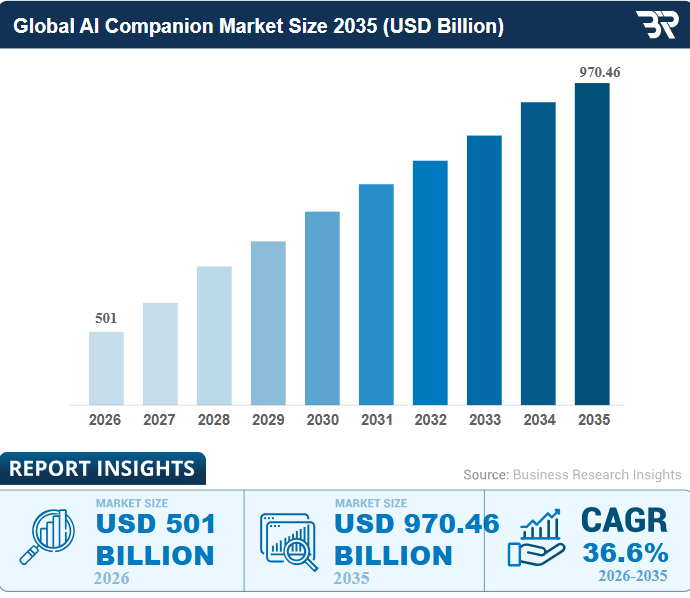
The global AI companion market is valued at $501 billion in 2026 and projected to reach $970.46 billion by 2035. Key growth drivers include rapid AI advancements, demand for mental health support, rise in artificial companionships, and workplace productivity tools.
-
Broad Market Scope
The AI companionship market isn’t just limited to romantic relationships. You can scale into fitness coaching, mental wellness, elderly care or language learning. The market is wide open, and exploring the less competitive niches helps to build niche authority.
-
User Engagement & Tailored Experiences
AI models can predict patterns and user behavior through adaptive learning. The highly personalized experience enhances engagement, user retention and builds authentic connections.
For example, if a person seeks an AI emotional companion to reduce anxiety, the model picks up the user’s personality and emotional tone over time. It addresses users’ concerns and generates empathetic responses.
-
Scalable Business Model
The virtual companionship business model is highly scalable. Platform owners can expand their monetization streams, scale their business globally and broaden the platform scope to other unexplored niches.
What is an AI Companion? How Does it Work?
An AI companion platform uses natural language processing and emotional intelligence to simulate human-like conversations and engage users. This intelligent system offers companionship, emotional support, and intimacy by adapting to different personas and recalling details across sessions.
So, AI companions can hold engaging conversations, suggest recommendations and even provide around-the-clock support.
How Do AI Companions Work?
They are shaped around important principles and concepts. Fundamentally, core intelligence, memory, and personalization systems work together to help AI companions generate responses.
Here are the key components of AI companion platforms:
- User Input & Context: Chat, voice messages, or images are the starting point of the conversation. The context from past interactions helps AI to generate more relevant and personalized responses.
- Persona: The dynamic persona modeling adjusts the response based on the model’s personality, interests, and communication style. Accordingly, the key entities and details are extracted from the user input.
- Memory: This includes short-term and long-term memory that tailors context-aware responses ensuring the companion remembers all conversations. The short-term memory stores recent conversations, while the long-term memory captures the user’s preferences and important events.
- LLM Model: This is the core engine that generates realistic human-like responses based on the given prompt. LLMs like GPT-4, Mistral, Claude evaluate the memory inputs and character persona to generate the final response.
- Final Response: The final output is sent to the user and also stored in context and memory for future conversations. The model learns from each output and refines its quality of conversation responses.
How to Build an AI Companion Platform: Step-by-Step Guide
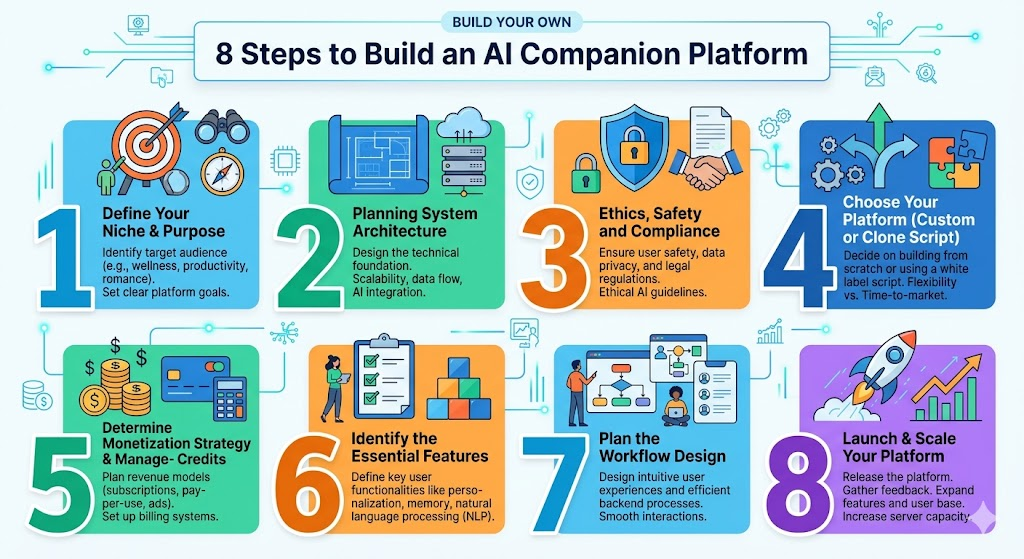
Developing digital companions need clear strategy and planning. Let’s navigate through the 8 key developmental steps!
1. Define Your Niche & Purpose
The first step to building a successful AI companion platform is to decide your niche. Are you planning to build your own AI companion platform for coaching or study help? There are enormous ways in which businesses can use them to help their target audience.
While the romantic companions and virtual girlfriend apps seem to be the most popular ones, you can target other underserved niches as well.
Here are the top niches & their monthly search volume:
- Romantic companions or virtual girlfriend / boyfriend apps – 40
- Mental wellness coach / AI mental health companion – 40
- AI gaming companion -70
- AI companion for seniors – 110
- Desktop companions -170 (OpenAI launched ChatGPT desktop and Anthropic introduced Claude Cowork in this space)
- AI writing companion – 140
- AI Fitness companion – 10
- Language learning companion – 0
Top AI companion Niches & Search Volume
You can target a niche with high search volume, rather than a broad parent term. The AI companion space is really moving fast, and the key is to niche down and establish a clear market positioning.
2. Planning System Architecture
Modern virtual companions are no longer a simple conversational layer atop LLMs. They are multi-layered machine learning systems working with NLP, vector databases, adaptive learning, and multi-modal systems at their core.
High-level Modular Architecture:
- LLM Model (Core AI Engine) This is the heart of the AI companion platform that generates context-aware and emotional conversations. It includes NLP, emotional state, and memory retention systems working together to build a tailored response.
- Personalization Layer – This layer collects behavioral data, user interests, sentiments and feeds them into the model. This further guides and provides the model with conversational direction.
- Memory Architecture – The deep memory layer differentiates companion platforms from traditional chatbots. The AI memory system stores chat history, user preferences and emotional patterns. The memory retrieval pipeline uses the current conversation state to send queries to the vector database.
- Multimodal Layer – The machine learning model is capable of processing information from different types of data, such as text, image and voice. For instance, sentiments from text prompts can even influence voice modulations or image outputs.
- Safety & Ethical Layer – This is the most critical layer that controls input and output to build a safe conversational experience for users. Often AI models need to handle bias, hallucinations, prompt injection and harmful content. Setting up restrictions or usage limits creates safe and compliant systems.
3. Ethics, Safety and Compliance
While AI companions are advancing at a rapid pace, it’s critical to address the ethical concerns related to emotional attachment and data privacy.
Popular virtual companion platforms like Character AI and Replika are increasingly being used as substitutes for human relationships. Overdependency on these AI models might lead to addictions and mental health issues. Implementing guardrails ensures AI operates within ethical and legal boundaries.
Crucial Ethical Safeguards
- Age Verification – Ensure your AI companion platform verifies users’ age before allowing platform access. Add strict age filters prohibiting minors from viewing adult content. If your platform is for teens, you can set up time limits to reduce over-usage.
- Privacy and Security – AI companions often collect sensitive and confidential user information. Data breaches can expose all the stored user credentials, which affects the brand reputation. An effective solution is to maintain transparency on what data is collected, how it is stored and used. Also, confirming user consent before collecting data is essential.
- Controlling Bias & Stereotypes – AI models are trained on specific datasets, which might produce biased outcomes or prejudice against certain groups. Gender discrimination or social inequalities are common biases which could reflect in the ongoing conversations. Train models on different datasets and conduct regular audits to ensure transparency.
- Mental Health Safeguards – New York is the first state to enact a mental health statutory provision for virtual companions to protect vulnerable AI users. As per the guidelines, platforms must integrate suicide prevention protocols and raise awareness about interactions with AI systems.
- Regulatory Considerations – California’s Transparency in Frontier AI Act and New York’s RAISE Act mandates disclosure of AI safety frameworks, incident reporting and risk assessments. While the Frontier AI Act is the first U.S. frontier safety AI law, RAISE Act is modeled closely on its framework and defines rules for AI developers.
4. Choose Your Development Approach (Custom or Clone Script)
Developing an AI companion platform requires technical knowledge for managing model integrations, fine-tuning, and cost estimation. Even after development, you need to evaluate performance for different metrics like accuracy, latency responses, bias, and conversational quality.
Even with an in-house team, you might struggle with efficiency, ethics, scalability, and cost gains. Buying a white-label AI companion clone is an affordable alternative for custom development. While building from scratch takes 4 to 12 months, launching with a white-label clone script reduces the timeline to 1-2 weeks.
Custom Development vs White-Label Clone Comparison:
| Factor | Custom Development | White-Label Clone |
| Launch Time | 4-12 months | 1-2 weeks |
| Cost | $15,000 – $150,000+ | Starts from $9000 for MVP platform (depends on AI model selection) |
| Scalable | High | High |
| Risk of failure | High | Low |
| Customization & Brand Differentiation | High | High |
| Maintenance & Support Costs | Complex and expensive support cycles | Low maintenance cost; support offered by the clone script provider |
| Best For | Platforms with unique requirements | Startups and entrepreneurs seeking a quick and affordable launch |
Why Choose Fanso.io?
Fanso.io has helped businesses launch successful digital companion platforms across different niches. Top features of our AI companion clone include:
- Real-time chat interactions
- AI image generation modules
- Character personalization & memory retention
- Diverse monetization streams
- Admin dashboards for complete platform and branding control
- Multilingual support for localization
We offer custom-built clone solutions tailored to your preferred niche, business goals and branding requirements.
5. Determine Monetization Strategy & Manage Credits
Implementing the monetization layer is a crucial step in virtual companion development. The right revenue streams help to sustain and scale AI companion platforms.
Common monetization models include:
| Monetization Strategy | How Does It Generate Revenue? |
| Subscription Plans | Subscription tiers including standard plan for basic features and pro plans for advanced personalization and long-term memory, generates predictable revenue. |
| Tokens/Credits | Token or credit packages for small feature unlocks like higher memory, image or video generation, voice conversation, and NSFW mode. This typically employs a usage-based monetization model and prompts users before reaching the usage limit. |
| Feature Add-ons | By implementing a freemium model, users can unlock customization features and high-quality conversations. |
| Virtual Gifts | The platform can earn additional revenue from virtual gifts like flowers, digital animations, accessories that boost engagement and user retention. |
| Voice Calling | Voice calls charged on per minute basis or as separate feature add-on is a strong revenue stream. This provides an advanced interaction-level with virtual companions. |
| White-label Licensing Model | Earn revenue by licensing your platform to enterprises or customers |
| Affiliate Partnerships | AI companion platforms can earn commissions by promoting dating apps, coaching platforms, and mental wellness apps. |
6. Identify the Essential Features
Integrating the core features builds a solid foundation for your AI companion platform. Once you build a powerful core, you can later enrich your platform with advanced features.
- Onboarding & Profile Setup – Build a seamless user onboarding experience prioritizing user preferences and needs. After onboarding, they can modify their profile details and choose the AI personality.
- AI Chat System – Provide a seamless chat module that enables human-like text responses, context-aware sessions and long-term engagement.
- Character Personalization – Users can adjust the AI character’s personality, emotional depth, custom avatar and communication style to suit their needs and goals.
- Memory & Context System – Structured memory helps to store past conversations, relevant user preferences and interests (favorite hobbies and food choices), etc. This helps to build a distinct AI character persona.
- Emotional Analysis – AI models can analyze a user’s emotional tone, mood and generate empathetic responses.
- Content Moderation & Security Features – This includes safety filters, age verification, and moderation flows for protecting users from harmful content.
- Subscriptions & Monetization – Provide basic subscription plans and premium upgrades for conversation continuity, advanced AI personalization, and long-term memory.
- Voice Interaction – Integrate with ElevenLabs (TTS and STT) or Whisper AI (STT integration) for voice-based interactions.
- User Analytics & Dashboard – Track active user sessions, real-time engagement, platform trends, revenue and optimize performance over time.
- Multimodal Interaction (Optional) – Multimodal pipelines enable the AI model to process text, image, video and voice inputs and generate responses.
7. Plan the Workflow Design
Once you build the complete feature set, it’s time to decide essential platform flows.
Here’s a basic workflow example defining an ideal user journey:
- Landing Page – This is the entry point that leads users to the AI companion platform. Keep it simple, engaging and inviting. Highlight the platform features, steps of AI interactions, FAQs, user reviews and clear CTA like “Create your AI companion” leading to the signup page.
- User Onboarding – The onboarding module includes simple and secure sign-up along with social logins. Once a user creates a profile, they can start with persona setup. Here, they build the AI model’s personality (e.g., friendly, witty, supportive), tone, style and even define constraints.
- AI Chat & Dashboard – This is the functional core of the platform. Here, an LLM like GPT-4 generates actual responses using memory and emotional state signals.
- Subscriptions & Chat Credits – Monetization flows such as subscriptions, chat credits and token, power functionality and revenue generation.
The safety layer includes content or age filters that businesses need to apply across the required modules.
8. Launch & Scale Your Platform
After developing the MVP platform and setting workflows, perform beta testing and gather early feedback. Identify the significant bugs, issues and optimize user experience.
Finally, deploy your AI companion platform for public use. This is an important step which involves integrating and deploying the AI and NLP models into the real-world scenario.
Now that you have a clear idea about your MVP platform, it’s time to develop a full-fledged platform.
Scaling your companion platform involves:
- Adding new functionalities like voice, AI generation
- Expanding your platform’s user base across diverse languages.
- Setting up new monetization flows, such as in-app purchases, virtual gifts, voice calling, etc.
- Technical scalability includes integrating load balancers, multimodal pipelines and CDNs.
- Market with influencer partnerships, SEO techniques, and social media.
Cost of AI Companion Platform Development
The cost to build an AI companion platform ranges from $15,000 to $150,000+, depending on project scope and complexity. White-label clone scripts help you launch your platform for $9,000 (MVP) within 1-2 weeks.
AI Companion Platform Cost Breakdown based on Complexity
| Platform Complexity | Features | Estimated Cost |
| Basic Companion Platform (MVP) | Simple text chat, user onboarding, profile setup and basic memory module | $15,000 – $30,000 |
| Medium-Level Platform | Character personalization, expanded memory, image-generation, subscriptions, better NLP responses and mood detection. | $30,000 – $60,000 |
| Advanced Platform | Advanced analytics,voice calling, video generation, custom personality engine, and diverse monetization streams. | $60,000 – $150,000+ |
Factors Influencing Development Cost:
- Project complexity
- AI & NLP model selection
- Developer expertise & team location
- Memory & context requirements
- Advanced multimodal integrations
- Fine-tuning and model maintenance costs
Recommended Tech Stack for Your AI Companion Platform
Choosing the right tech stack is crucial for building a high-performance and interactive virtual companion platform. Identifying robust tools and technologies enables you to balance technical feasibility, scalability and platform budget.
| Tech Stack | Core Technology | Purpose |
| Frontend | React.js, Next.js for web
Flutter/ React Native for mobile development |
Helps to build responsive interface for user interaction |
| Backend | Node.js/ Express.js, Python, Django, | Implement business logic, manage user sessions, payments and authentication flows |
| Databases | MongoDB, PostgreSQL, Redis and Vector databases (Pinecone,ChromaDB and Weaviate) | Store user data, manage short term and long-term memory across sessions |
| AI & NLP Models | LLMs: GPT, Claude models, open-source models like Llama, Mistral
Voice & Multimodal Integration: ElevenLabs, Whisper |
LLMs simulate human-like conversational responses.
Multimodal integrations help with text-to-speech conversion. |
| Cloud Hosting & Deployment | AWS, Google Cloud, Azure, Docker and Kubernetes | For high-performance and scaling computational resources |
| Security & Compliance | JWT, OAuth 2.0 | Privacy, safety and compliance layer |
| Analytics | Mixpanel, Google Analytics | Monitor key performance metrics |
| Third-party Payment Integration | Stripe, PayPal
CCBill, Epoch, Verotel (Adult platforms) |
Accept subscription payments, wallet transactions, feature upsells, etc. |
Challenges for Building a Virtual Companion Platform
Building an AI companion platform is a complex process,from choosing the right LLM model to fine-tuning datasets and ensuring safety at each development stage. As an entrepreneur, there are technical, functional and ethical challenges throughout the journey.
The following are the common challenges in the development process:
-
Personality Consistency
Occasional persona drift and repetitive messages can reduce engagement over time. This happens because maintaining a coherent personality across sessions requires the use of memory architectures.
-
High Development and Maintenance Costs
Robust infrastructure, fine-tuning, and API calls quickly scale up development costs. Unlike traditional software, which scales linearly, AI platforms often experience exponential growth due unpredictable token usage and training needs.
-
Monitoring & Updating Models
Without continuous monitoring and timely updates, AI models often lack accuracy. Regular optimization from user feedback and new training data keeps the model updated.
-
Managing Performance & Latency Issues
Users often expect quick and high-quality responses in AI companion platforms. However, AI processing, high demand, and misaligned model integrations can cause delays. Set up efficient data pipelines and model optimization to scale up performance.
Conclusion
The AI companionship market looks promising both in terms of revenue generation and relevant emotional support. Zoom AI tools, Character AI and Replika’s massive success prove the solid market potential.
Innovation lies in tapping into top trends like AR/VR integration, using contextual memory for human-like interactions, and real-time emotional adaptation. However, still the top challenge is integrating the safety control and monetization flows with the actual tech infrastructure.
While the era of digital companionship has just begun, you can make it big by launching an intelligent digital companion with a skilled development team. Book a free 15-minute discovery call to build your AI companion today!
Further Reading:
FAQ-Related to How to Build an AI Companion Platform
1. How much does it cost to build an AI companion platform?
The cost of building an AI companion platform is approximately $15,000 to $150,000+, depending on features, tech stack, AI model selection and developer rates. White-label clone scripts cost significantly lower, starting at $9000 for MVP development.
2. How long does it take to develop an AI companion app?
A basic AI companion app (MVP) takes 4-6 months of development, while advanced features like voice integration and context retention take 6-12 months. White-label clone solutions reduce the project timeline to 1-2 weeks.
3. How to create an AI companion platform without coding?
Yes, you can build AI companion platforms without any coding skills using white-label solutions and launch with a lower budget.
4. How do AI companion platforms make money?
AI companion platforms monetize from subscriptions, tokens or credits, selling custom characters, and feature upsells.
5. How do AI companion apps store memory and conversation history?
AI companions use database systems, vector storage and cache retrieval to provide faster recall and conversational responses. The short-term memory stores recent conversations, while long-term memory recalls user personality traits and preferences across sessions.
6. What are some effective strategies to scale your AI companion platform?
Multiple character personalization, image and voice generation, expanding memory and context, and supporting dynamic language translation are ways to scale your platform.
7. Which AI model is best for companion apps?
OpenAI’s GPT-4 and GPT-5, Claude, and open-source models like Llama and Mistral are recommended models. While GPT models are ideal for short conversations, Claude models are best suited for context-driven messages.
8. What database is used for storing AI chat history?
PostgreSQL, MongoDB, Firebase, and Redis are recommended beginner-friendly options. While long-term memory and personalization requires vector databases like Pinecone, ChromaDB and Weaviate.