
TL;DR
- The global companion market is valued at $49.52 billion in 2026 and estimated to reach $435.9 billion by 2034, growing at a CAGR of 31.24%.
- Building an app like CrushOn AI requires three essential modules: an intelligent AI character engine, an emotional center, and long-term memory systems.
- Your MVP platform must include simple onboarding, an AI chat interface, a character engine, analytics, payment and subscriptions, moderation, and safety controls.
- Choose LLM open-source models like Llama-3.1-8B or Mistral to balance efficiency, performance, and cost.
- White-label companion clone solutions by Fanso reduce the development timeline to 1-2 weeks from 4-12 months and also lower the estimated cost.
If you’re planning to build a virtual companion platform, you’re entering into one of the fastest-expanding industries on the internet. CrushOn AI is a popular digital companion with immersive roleplay and dynamic AI chat.
With more people turning to AI characters for companionship, this business model has excellent financial potential with less investment. This guide on “how to build an app like CrushOn AI” covers key features, developmental steps, LLM model comparison, and cost expectations. So, let’s get into it without much ado!
What is CrushOn AI?
CrushOn AI is a powerful conversational app that allows interactions with AI personas supporting unfiltered emotional roleplay and storytelling. Unlike Character AI, the platform imposes fewer content restrictions and allows uncensored AI chat.
The platform uses NLP, context-aware systems, memory, and adaptive AI learning to generate realistic conversations.
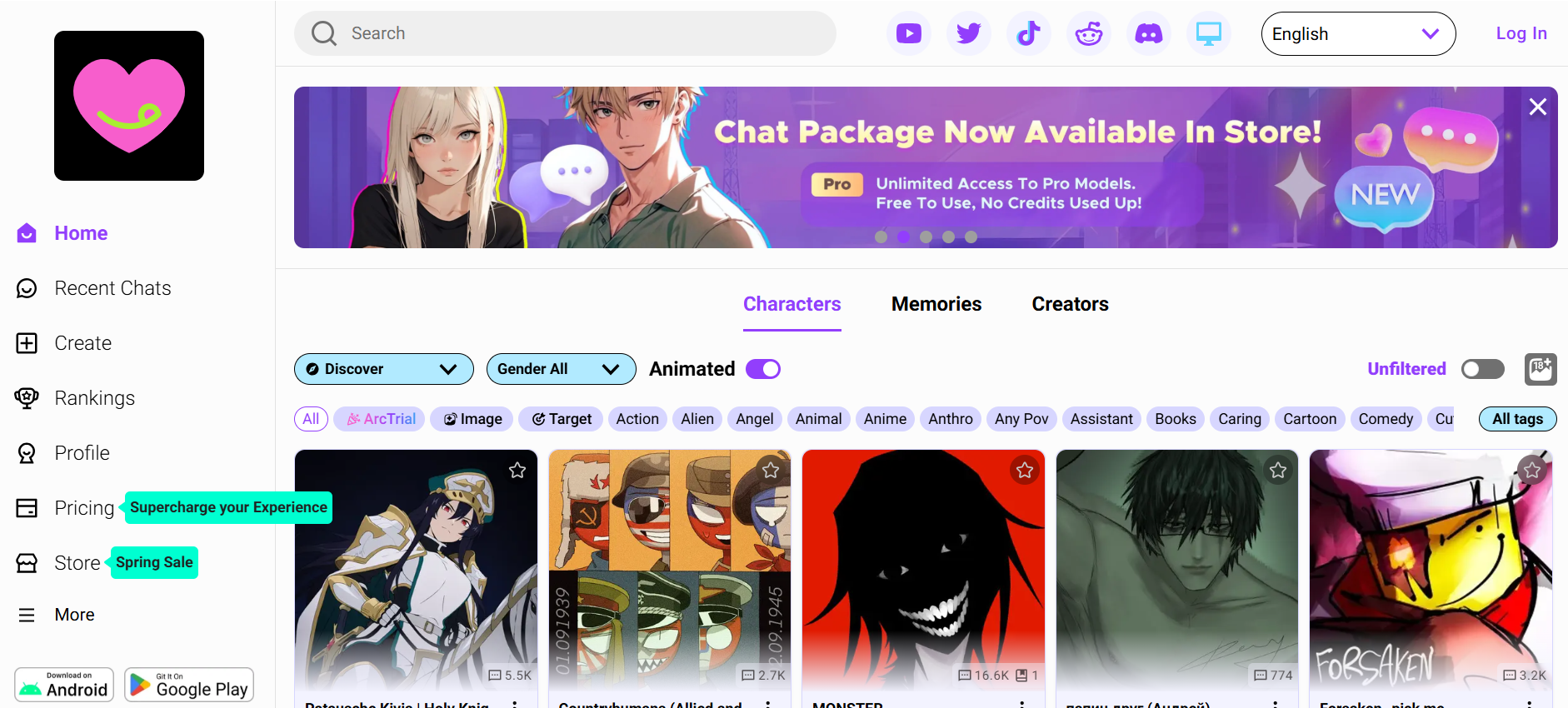
Key platform characteristics include:
- Supports natural conversations and group chats
- Broad range of AI personas
- Custom AI character and creation tools.
- Remember past conversations and tailor personalized responses
- Strong privacy & encryption features
- Subscription tiers and virtual coins as rewards
- Multilingual support across 15+ languages.
Why Build an App Like CrushOn AI?
Here are the key reasons for building an app like CrushOn AI:
-
Growing Market Demand
The global AI companion market size is valued at $49.52 billion in 2026 and projected to reach $435.9 billion by 2034, growing at a CAGR of 31.24% from 2026 to 2034. Creating a CrushOn AI app means capturing a share of this booming companionship market and earning high revenue.
-
Immersive & Personalized Conversations
AI companion platforms allow conversations with dynamic virtual personalities and engaging roleplay scenarios. Long-term memory and context help to generate personalized responses, boosting user retention.
-
Less Restrictive Content
Unlike Character AI, launching an NSFW companion provides users more freedom for emotional roleplay. Besides, users are more willing to pay to explore deep fantasies and imaginative storytelling through conversations.
-
Build a Strong Community
Creating an anime-style or RPG companion platform builds a strong niche community and long-term relationships. This is an effective strategy to differentiate your platform with a unique market positioning.
What are the Features for CrushOn AI Development?
Here’s a core feature list for developing a successful CrushOn AI app:
- Login & user authentication: User onboarding involves registration, profile setup and gathering user preferences. Allow users to sign in with email ID, Google and Microsoft accounts.
- AI chat: Modern conversational bots use NLP for generating human-like responses. This is the app’s core and allows users to define AI personality, choose conversational style and even 3D avatars.
- Character Personalization: The persona engines are decision-making modules that communicate with memory, LLMs, emotional modules and vector databases to generate realistic responses. You can use prompt templates to define the personality.
Example: “You are Lara, an empathetic AI companion, who acts as an emotional well-being coach.”
- Emotional Intelligence: This feature makes the companion app more relatable and empathetic. It analyzes the user’s tone, sentiment, and mood replies accurately instead of sounding boring or robotic.
- Analytics & Reporting: Built-in analytics helps to track engagement, user behavior, and response accuracy. By evaluating these metrics, companies can optimize their platform performance and enhance user satisfaction.
- Monetization Flows: Build a secure payment workflow to accept subscriptions, credit, and token payments.
- Privacy & Safety Controls: Establish clear privacy policies, data collection and communication rules regarding your platform. Include privacy-first account settings, session authentication, and threat monitoring systems.
Advanced Features:
- Multimodal interactions
- Long-term memory and context-aware systems
- 3D avatars
- Multilingual support
- Advanced analytics
- Image-to-Text
- Recommendation engine
- Advanced moderation & security controls
While essential features build the platform foundation, advanced features elevate user experience. It drives innovation and establishes your niche authority.
Step-by-Step Guide for Building an App Like CrushOn AI
Here’s a detailed implementation guide for developing CrushOn AI app:
Step 1: Define Your Platform Idea and Scope
The first step in companion app development is brainstorming a viable project idea. Instead of blindly creating an NSFW companion app, find your app’s USP. You could create a companion for gaming, a voice-first AI companion, or one specific to the anime genre.
Spend some time researching how you can solve an actual problem and attract your target audience.
Some key questions to ask are:
- Who is your target audience?
- What are the platform gaps of CrushOn AI and its competitors?
- Which AI models will you use in your app?
- What is the personalization level and memory required?
- Are you allowing adult content in your app?
- How would your platform monetize?
Also define the project scope, including project objectives, milestones, budget, team, deliverables, and MVP timeframe at this stage.
Step 2: Choose the Monetization Model
AI development has several hidden cost drivers, from computing expenses to model optimization. Hence, identifying a robust monetization strategy is crucial to balancing these expenses with platform revenue.
Traditional SaaS platforms prefer subscription-based monetization over credit usage. However, AI apps favor credit-based systems due to their high cost variability.
Take, for example, CrushOn AI. It uses a freemium model with a message-based credit system. It offers three plans: free (50 messages per month), standard plan at $5.9/month (2,000 messages), premium plan at $14.9/month (6,000 messages), deluxe plan at $29.9/month (15,000 messages). And the credits reset every month.
When you implement credit-based systems, users can purchase a package with fixed credits/tokens and spend on text replies, image generation, NSFW mode, etc. The best part is that businesses can handle variable AI costs and adjust pricing for premium features.
Step 3: Choose the Right LLM Model
Selecting the right LLM model is one of the most significant decisions for building an app like CrushOn AI. Valuable advice is to choose the best-suited LLM rather than the most powerful ones.
There are different types of LLM models: base models, instructor-tuned and chat-tuned models. Chat-tuned models are most recommended as they are ideal for natural conversations. Evaluate your performance and resource-efficiency requirements for model selection.
Popular LLM models for conversations include:
- Proprietary Models (Strict filters): GPT-4, GPT-4o, Claude 3.5, Gemini 2.0 (for multimodal integrations)
- Open-Source Models (Less Restrictive and uncensored models): Hermes-3 Llama-3.1-8B, Yi-1.5-9B-Chat, Humanism-Roleplay-Llama-3.1-8B, OpenChat-3.5-1210 (Hugging Face), Mistral
Key Considerations:
- Size of the model (8B parameter count recommended)
- Chat quality
- Latency & speed responses
- Strong context understanding
- Persona drift
- Cost-to-quality ratio
LLM Model Comparison
| Model | Conversation Quality | Context Window | Speed | Open-source | Multimodal Support | Cost (per 1 M tokens) |
| GPT-4 | High | Moderate | Moderate | No | Moderate | High |
| Claude 3 | Moderate | High | Fast | No | Moderate | Moderate |
| Llama-3.1-8B | Good | Good | Very Fast | Yes | Limited | Low |
| Gemini 2 | Moderate | High | Fast | No | High | Moderate |
| Mistral | Good | Moderate | Fast | Yes | Limited | Moderate |
Step 4: Design an Intelligent AI Character Engine
The character engine is the core system of the companion app. It decides your AI character’s personality, emotional intelligence and memory.
Let’s discuss the core architecture of the conversational engine.
- Personality Engine: This provides the AI model specific personality traits, interests and communication style to make interactions more familiar. Avatar is a core part of an AI model’s visual identity and helps users associate the model with a distinct personality.
- Memory System: Maintains vector databases to store user preferences and conversation history across sessions. The in-memory or short-term memory stores recent conversations, while long-term memory stores key event details and emotional states. Relational databases are used as long-term memory for capturing user profiles, subscriptions, preferences, and chat summaries.
- Emotional Module: Embeds key nuances into responses by capturing sentiment, emotional state and mood.
- Adaptive Learning: The LLM learns from each conversation input to improve over time. This involves monitoring real-time inputs and adjusting responses based on the model’s analysis and learnings, rather than providing generic responses.
Thus, the final LLM prompt is a combination of current user input, conversational history and selected persona.
Step 5: Implement the Safety and Compliance Layer
Ensuring companion ethics helps to protect user data and revenue. Modern businesses dedicate a significant portion of their budget to build a robust ethical layer.
Essential ethical safeguards include:
- Age Verification: Companion apps need strict age filters allowing only users over 18 years of age. This protects minors from exposure to inappropriate content.
- Crisis Detection Model: AI companions tailor their responses to the user’s emotional tone and behavior and hence need appropriate safety frameworks. Moreover, they are not trained to handle vulnerable users showing patterns of self-harm. Companions need to route such requests to quality human support to avoid adverse outcomes.
- Chat Filters & Moderation Controls: Implement appropriate input guardrails for prompt injection or suspicious cyber attacks. It is crucial to set up chat filters for identifying toxic behavior, explicit content, and offensive language.
- Regulatory Adherence: California’s chatbot law requires operators to issue clear reminders about AI interactions and safety protocols for minors. EU AI Act’s sets out legal obligations for informing users that they are conversing with AI and clear labelling of AI-generated content. In short, regulators mandate clear disclosures, safety frameworks and age-verification for companion chatbots.
- Audit Review: Maintaining audit logs makes it easier to identify safety issues, errors and fix problems early. Track key metrics such as model accuracy, conversational quality and fairness continuously. Employ human-in-the-loop mechanisms to monitor user behavior and AI model drift.
Step 6: Testing & Deploying the App
Before launching, it’s crucial to test if the app works smoothly as well as fix all the bugs and performance issues. Another pre-deployment task is to train the AI models on your niche data and connect your platform with essential third-party services.
Deploying the app involves server configurations and setting up memory and moderation pipelines. Vercel, AWS EC2 or Google Cloud is the recommended deployment stack.
Step 7: Monitoring & Scaling
Once your app is live, monitor its performance, response rates and optimize token usage. Ensure your app’s performance aligns with the user needs and solves latency issues.
Track these key metrics:
- Conversational quality
- Accuracy
- Latency issues
- Memory and recall
- Persona consistency
- Safety guardrails
Implement feedback loops and optimize as per real-world interactions. Lastly, monitor performance and update models for long-term stability.
To gain momentum, scale your CrushOn AI-like app across a diverse user base. Add advanced features and expand your app’s context window and memory. Include voice, image and video generation integration to build immersive platform experiences.
Recommended Tech Stack for CrushOn AI Development
| Tech Stack | Core Technology | Purpose |
| Frontend | React.js, Next.js for web
Flutter/ React Native for mobile development |
Helps build responsive UI |
| Backend | Node.js/ Express.js, Python (FastAPI) | Business & API logic, handle payments, sessions and user authentication |
| Databases | PostgreSQL, MongoDB, Redis; Vector databases (Pinecone,ChromaDB and Weaviate) | Store user data & conversation history |
| AI & NLP Models | Open-source models like Mistral, Llama, voice models (ElevenLabs, Whisper)
Note: Claude, Gemini and Open AI typically prohibit the use of LLM for adult products. But can be used for companion chat and non-explicit roleplay. |
Build conversational core and voice interactions |
| Cloud Hosting & Deployment | AWS, Google Cloud, Microsoft Azure, Vercel | Helps with secure deployment |
| Authentication | JWT, OAuth 2.0 | Enables secure login and authentication |
How Much Does It Cost to Build a CrushOn AI Clone?
The cost to build a CrushOn AI app costs $30,000 for a basic app and over $150,000 for a full-featured solution. While these figures are just a baseline, the actual numbers depend on business goals, project scope, and other external factors.
AI Companion Platform Cost Breakdown based on Complexity
| Platform Complexity | Features | Estimated Cost |
| Basic Companion Platform (MVP) | Simple chat module, basic memory module, and payment integration | $30,000 – $60,000 |
| Medium-Level Platform | Dynamic persona, long-term memory, image-generation, voice features and analytics | $60,000 – $80,000 |
| Advanced Platform/ Enterprise-Grade Solutions | Video generation, AR/VR integration, avatars, multi-language support, enterprise features | $80,000 – $150,000+ |
Factors Affecting CrushOn AI Development:
- Feature complexity: Integrating voice calling, avatars, and video generation increases development costs.
- UI/UX Design: Designing an advanced frontend interface and sophisticated UI is expensive.
- Integration of complex AI models: LLMs, NLP models, and multimodal integration consume tokens for every prompt, often exceeding your set budget.
- Developer Expertise & Team Location: Businesses often outsource development to external development teams with varying hourly rates. Development in North America and Western Europe costs $100 – $200/hour and $65 – $180/hour, respectively, while it costs less in Asia and Eastern Europe.
- Hidden AI cost drivers: Token usage, training costs and API plans quickly scale up development costs.
- App maintenance costs: Regular model training and updates are crucial for maintaining accuracy and efficiency. Post-launch maintenance and support costs are often overlooked by businesses.
Why Choose Fanso.io to Develop CrushOn AI App?
Fanso.io is the ideal partner for CrushOn AI development, given its AI specialization and development expertise.
We specialize in building custom-built companion platforms ensuring a personalized, scalable and secure business. With over 10 years of experience building creator platforms and AI-driven marketplaces, Fanso leverages modern technology and robust architectural systems,
The white-label clones are an affordable launchpad for entrepreneurs stepping into the growing companion market. Whether you are planning to build an anime-style companion or an advanced platform with multimodal capabilities, our clone solution is highly customizable to your niche.
Ready to create your AI companion? Book a free discovery call with our team to validate your business idea and launch a successful AI chat app!
Wrapping Up
The companionship market is definitely promising for new entrepreneurs, given the massive demand, creative freedom and control. New entrepreneurs can launch a text-based app with basic memory and later scale as more users sign up.
Another essential point to keep in mind is to consider ongoing AI subscription expenses and maintenance costs during budget estimation. This eliminates unnecessary last-minute costs and management hassles. AI companions are no longer simple conversational tools, but the future of human interactions, so seize this massive business opportunity!
Further Reading:
FAQ-Related to How to Build an App Like CrushOn AI
1. How long does it take to build an app like CrushOn AI?
Developing an MVP app with custom development takes 4 to 6 months. Advanced features like voice interactions, long-term memory and custom character engine extend the timeline to around 8 to 12 months. White-label clone scripts reduce launch time to 1-2 weeks.
2. Which AI technologies are used in CrushOn AI?
LLMs, NLP, memory systems, and multimodal AI are popular technologies for the development process.
3. What are the best alternatives to the CrushOn AI app?
Top alternatives for the CrushOn AI app are Candy AI clone, Character AI, and Replika.
4. How do apps like CrushOn AI make money?
CrushOn AI app monetizes from subscriptions, credits/tokens, feature upsells, virtual gifts, voice calling, and an API licensing model.
5. Can Fanso.io build my CrushOn AI app?
Absolutely, you can use an expert like Fanso.io for AI development, superior digital companions and data security tailored to your niche.
6. What are the biggest challenges for building a CrushOn AI app?
Data privacy, compliance, performance issues, maintaining persona consistency, high development and maintenance costs are key challenges.
8. How to reduce the cost of developing CrushOn AI?
White-label clone script by Fanso helps to build the MVP platform starting at $9,000, thus reducing the overall development costs.