
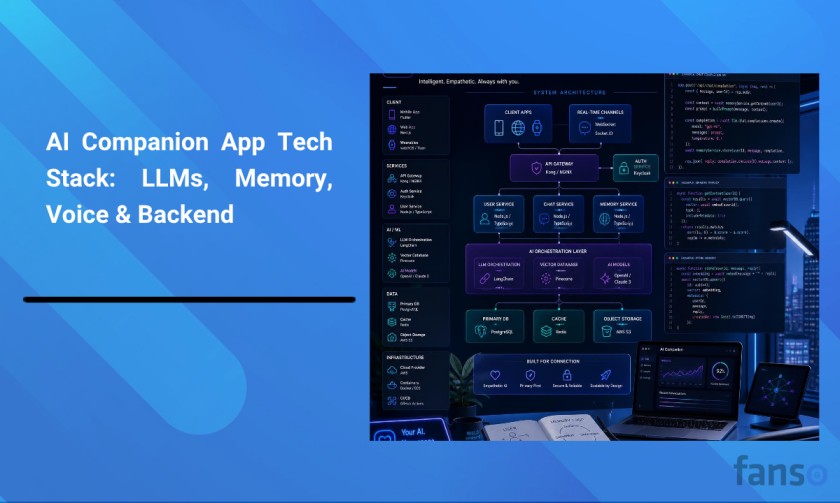
TL;DR: AI Companion App Tech Stack
- AI companion apps combine LLMs, memory, voice, image generation, databases, APIs, and real-time services into a coordinated platform architecture.
- LLM selection depends on dialogue quality, context handling, tool support, latency, customization, operating cost, and whether inference is managed through APIs or self-hosted infrastructure.
- Memory systems use short-term conversation context, long-term memory, embeddings, vector search, and retrieval processes to maintain relevant information across sessions.
- Voice and multimodal capabilities require dedicated STT, TTS, image generation, vision, media storage and real-time processing components, with asynchronous workflows for resource-intensive media tasks.
- A scalable backend connects AI services, databases, caching, WebSockets, queues, and model-routing systems, with the technology stack evolving from a compact MVP architecture to production infrastructure based on traffic and workload requirements.
An AI companion platform requires an architecture that can manage conversational AI, user context, persistent memory, voice interactions, media generation, and real-time communication. The LLM generates responses, while supporting services manage conversation history, memory retrieval, user data, and multimodal processing.
The backend coordinates these systems through APIs, databases, caching, queues, and real-time communication protocols. Technology choices also depend on expected traffic, response latency, media workloads, and infrastructure costs. Managed AI APIs can support early-stage development, while larger deployments may require model routing, dedicated inference infrastructure, vector storage, asynchronous processing, and distributed services.
This guide will discuss the core technologies behind AI companion platforms, including LLMs, memory, voice, image generation, backend architecture, and production infrastructure, with stack recommendations for MVP and scalable deployments.
Core Architecture of an AI Companion App
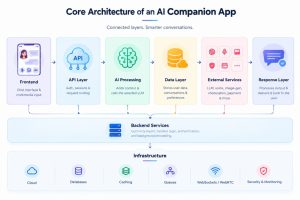
An AI companion app architecture consists of several connected layers that manage user interactions, AI processing, persistent data, and external services. Each layer has a defined responsibility, while the backend coordinates communication between them. Together, these components form the foundation of an AI companion technology stack.
How the Main Components Work Together
A typical interaction follows this flow:
- Frontend: Provides the chat interface and handles text, voice, and image interactions.
- API layer: Authenticates users, manages sessions, and routes requests to the required services.
- AI processing: Combines the user’s message with relevant context before sending it to the selected LLM.
- Data layer: Stores user profiles, conversations, preferences, platform state, and other persistent information.
- External services: Connects the platform to LLMs, voice, image generation, moderation, payment, and other third-party services.
- Response layer: Processes the generated output and delivers it back through the appropriate interface.
Building an AI companion platform typically connects these components through defined and service layers, allowing conversational AI, memory, personalization, and supporting infrastructure to operate as part of the same system.
LLMs for AI Companion Apps
The LLM handles message interpretation and response generation while following the companion’s defined behavior. It is a central component of an AI chatbot tech stack, with its implementation shaped by the model provider, deployment method, context requirements, and expected workload.
API-Based vs Self-Hosted LLMs
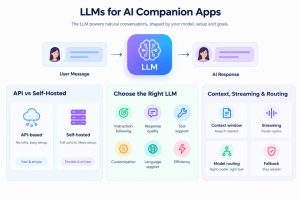
The first decision is where model inference will run.
- API-based LLMs: The platform sends requests to an external provider that manages model serving, GPU infrastructure, scaling, and inference operations.
- Self-hosted LLMs: Open-weight models run on infrastructure controlled by the platform owner, requiring GPU resources, model serving, monitoring, optimization, and capacity planning.
- API deployment: Reduces infrastructure management and allows teams to integrate capable models without operating their own inference environment.
- Self-hosting: Provides greater control over model configuration, deployment, and data handling but introduces additional infrastructure and operational requirements.
These considerations matter most when selecting the technology stack for a Candy AI-style companion platform, especially one that needs to support conversational AI, memory, voice, image generation, and real-time communication.
Choosing the Right LLM
Evaluate the model against the application’s actual conversational workload, not benchmark scores alone. Important criteria include:
- Instruction following: Maintains character rules and system-level constraints.
- Dialogue quality: Produces coherent and contextually appropriate responses across multiple turns.
- Tool calling: Supports structured interaction with platform functions where required.
- Customization: Provides suitable fine-tuning or adapter options when model customization is needed.
- Language support: Handles the languages required by the target user base.
- Inference efficiency: Meets the application’s response-time and operating-cost targets.
Use representative conversations during evaluation to compare models under realistic workloads. These considerations are also important when selecting the underlying model architecture for a Character AI-style platform with multiple AI characters and conversational behaviors.
Context Windows, Streaming, and Model Routing
Several mechanisms influence how an AI companion handles model requests:
- Context windows: Define how much input a model can process in a single request. Long conversations may require selective history, summarization, or context compression to keep the most relevant information within the available context.
- Streaming: Returns generated tokens incrementally rather than waiting for the complete response, allowing the interface to display output as it is generated and reducing perceived response latency.
- Model routing: Directs requests to different models based on factors such as task complexity, response requirements, latency, or cost. A smaller model can handle routine interactions, while a more capable model can handle complex requests.
- Fallback routing: Redirects requests to an alternative model or provider when the primary option is unavailable, overloaded, or fails to meet operational requirements.
Together, these mechanisms help control context size, response latency, model selection, and service reliability without placing every request on the same model or processing path.
Memory Architecture for AI Companion Apps
Memory determines what information an AI companion retains beyond an active interaction and can access during later conversations. A dedicated memory layer separates temporary conversation information from persistent user information and manages how it retrieves and updates stored memories. This makes memory a core architectural component for platforms built around long-term user interactions.
Short-Term vs Long-Term Memory
AI companion memory falls into two categories based on how long information needs to remain available.
- Short-term memory: Maintains information needed during an active conversation, such as recent messages, the current topic, and temporary interaction state.
- Long-term memory: Retains information that remains useful across sessions, such as user preferences, recurring interests, important events, or ongoing goals.
- Memory selection: Not every message should become a persistent memory. The platform should identify information with lasting value before storing it.
- Memory control: Updates or removes stored information when it becomes inaccurate, outdated, or no longer relevant.
This separation prevents persistent memory from becoming a copy of the user’s complete conversation history. Instead, the platform retains selected information that can support continuity across sessions.
Embeddings and Vector Search
Long-term memories can be represented as embeddings, which convert text or other supported information into numerical vectors that capture semantic relationships. When a user later asks something related to a stored memory, the platform can generate an embedding for the new query and use vector similarity search to identify relevant stored information, even when the wording differs.
A typical retrieval process includes:
- Identify information worth retaining.
- Generate an embedding for the selected memory.
- Store the memory, embedding, and relevant metadata.
- Generate an embedding for a later query when you need to retrieve memories.
- Perform a similarity search against stored vectors.
- Apply metadata or application-level filters where required.
- Return the most relevant memories to the application.
Metadata such as user ID, memory type, timestamp, or platform scope can restrict which records are eligible for retrieval. The resulting memories can then be added to the model’s context before generating a response. The specific vector storage technology can be selected based on the application’s backend architecture and expected retrieval workload.
Memory Retrieval and Updating
A memory system needs separate processes to retrieve relevant information and maintain stored memories. During a conversation, the platform retrieves information that can improve the current response. After or during the interaction, it can identify new information worth retaining and decide whether to update an existing memory.
A typical memory lifecycle includes:
- Retrieve: Find memories related to the current interaction.
- Filter: Exclude memories from the wrong user, scope, or category.
- Use: Pass relevant memories to the response-generation process.
- Extract: Identify new information with lasting value.
- Update: Modify an existing memory when newer information replaces it.
- Merge: Consolidate duplicate or closely related memories.
- Delete: Remove information that is outdated, incorrect, or requested for removal.
This creates a continuous memory lifecycle rather than an append-only store. The approach allows the companion to maintain relevant user information as preferences, plans, and other details change over time. Persistent memory is also a key consideration when building an app like CrushOn AI, where conversations can extend across multiple sessions.
Voice Technology for AI Companion Apps
Voice technology enables users to communicate with an AI companion through spoken input and receive generated responses as audio. The core pipeline combines speech recognition, language processing, and speech synthesis. These components add another layer to the AI companion technology stack, particularly for platforms that support real-time voice conversations.
Speech-to-Text and Text-to-Speech
- Speech-to-Text (STT): Converts spoken audio into text for processing by the conversational system.
- Text-to-Speech (TTS): Converts generated responses into audio for playback.
- Voice quality: STT should handle relevant accents, languages, and background noise, while TTS should deliver consistent, natural speech.
- Latency: Streaming transcription and speech synthesis can reduce the delay between user input and the companion’s response.
The selected STT and TTS services should be evaluated based on accuracy, supported languages, voice quality, streaming support, latency, and usage costs.
Real-Time Voice Streaming and Interruptions
Real-time voice interaction requires the system to process audio continuously while coordinating speech recognition, response generation, and audio playback.
- Streaming audio: Sends and processes audio incrementally instead of waiting for a complete recording.
- Turn detection: Determines when the user starts or stops speaking so the system can manage conversational turns.
- Interruption handling: Stops or pauses generated speech when the user begins speaking and prioritizes the new input.
- Real-time transport: WebRTC is commonly used for low-latency audio communication, while WebSockets can support real-time events and streamed data.
- Audio synchronization: Keeps transcription, model responses, and audio playback aligned during the interaction.
For platforms requiring lower latency, real-time voice models can process audio input and output within a unified interaction pipeline, reducing the need for separate STT and TTS stages.
Image and Multimodal AI Capabilities
Image capabilities allow AI companions to understand visual inputs and generate images based on conversations. The technology stack typically requires a vision-capable model, an image generation service, media storage, and moderation.
Image Understanding
Vision-capable models can process user-uploaded images and use visual information as part of a conversation.
- Image analysis: Identifies objects, scenes, and other visual elements.
- Visual question answering: Responds to questions about an uploaded image.
- Image-to-text: Extracts descriptions or relevant information from visual content.
- Multimodal conversations: Combines text and images within the same interaction.
Evaluate the selected model for visual accuracy, supported image formats, processing latency, context limits, and input costs. Models such as Gemini and OpenAI’s vision-capable models support image inputs for analysis and multimodal interactions.
AI Image Generation
Image generation allows companions to create character images, avatars, scenes, and other visual content from conversational prompts. Modern image APIs can also support image editing using existing images as inputs.
Key considerations include:
- Generation quality: Maintains consistency with the companion’s appearance and requested style.
- Character consistency: Uses reference images, prompt structures, and generation parameters to reduce visual variation between sessions.
- Editing: Modifies existing character images or scenes where supported.
- Latency: Generation time affects the user experience.
- Cost: Image generation can become a significant operational expense at higher usage volumes.
- Moderation: Generated and uploaded media should pass through appropriate safety controls before delivery.
Image generation often works better as an asynchronous workload so longer generation times don’t block the main conversation request. This approach becomes increasingly important for AI companion platforms that support frequent image generation alongside real-time text interactions.
Backend Architecture for an AI Companion App
The backend connects the platform’s interface with AI services, databases, external APIs, and other supporting systems. It manages requests, logic, data access, authentication, and background processing while keeping these operations separate from the frontend.
API and Conversation Orchestration
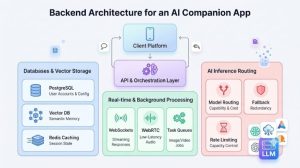
The API layer handles authentication, request validation, user permissions, sessions, and communication between the frontend and backend services.
The conversation orchestration layer manages the processing required for each user message. It can retrieve relevant conversation history and memory, apply character configuration and moderation rules, select the appropriate AI service, and coordinate the response before returning it to the application.
For larger platforms, these responsibilities can be separated into services for authentication, conversations, AI inference, media processing, payments, and moderation. Service boundaries let you scale individual workloads independently as traffic or processing needs increase.
Databases, Vector Storage, and Caching
Different data types require different storage systems. PostgreSQL or another relational database can store user accounts, subscriptions, character configurations, conversation records, and transaction data.
Vector databases handle embeddings used for semantic memory retrieval. The memory architecture determines what information to retain and retrieve, while the backend manages access to the selected vector storage system.
Caching reduces repeated database and service requests. Redis can store sessions, temporary state, rate-limit counters, and frequently accessed data. Cache expiration and invalidation are important to prevent outdated information from being used.
WebSockets, Queues, and Real-Time Processing
AI companion platforms often require real-time communication for streamed responses, voice interactions, and live status updates. WebSockets can maintain persistent connections between the client and server, while WebRTC can support low-latency audio communication for voice features.
Queues are useful for tasks that do not need to be completed immediately, such as image generation, video processing, notifications, and analytics. Dedicated workers can process these tasks without blocking the main API services.
Scaling AI Model Requests
AI inference can become a major source of infrastructure usage as concurrent users increase. The backend therefore needs to control how it distributes requests across models, providers, or self-hosted inference servers.
A model-routing layer can select an appropriate model based on factors such as capability, latency, availability, and cost. The surrounding request infrastructure should also manage concurrency limits, rate limiting, timeouts, retries, and fallback behavior.
Monitoring should track metrics such as response latency, token usage, error rates, request volume, and resource utilization. Separating model access behind a consistent platform interface also makes it easier to introduce new models or providers without changing the rest of the application.
Recommended AI Companion App Tech Stack
The following stacks provide practical technology combinations for two common deployment stages. The MVP stack prioritizes simplicity and faster implementation, while the production stack provides stronger options for platforms expecting higher traffic and more complex workloads.
| Layer | MVP Stack | Production Stack |
| Frontend | Next.js, React | Next.js, React, CDN |
| Backend | Node.js, FastAPI | Node.js, FastAPI, modular services |
| Primary Database | PostgreSQL | PostgreSQL with read replicas |
| Vector Database | pgvector | Qdrant, Pinecone, or optimized pgvector |
| Cache | Redis | Redis Cluster |
| LLM Integration | OpenAI, Anthropic | Multiple LLM providers + model gateway |
| Voice | Whisper, ElevenLabs | Streaming STT/TTS services |
| Image Generation | FLUX, Stable Diffusion APIs | Dedicated GPU inference or scalable APIs |
| Real-Time Layer | WebSockets | WebSockets, WebRTC |
| Background Processing | Basic workers | Distributed queues and workers |
| Cloud Infrastructure | DigitalOcean, AWS, Google Cloud | AWS or Google Cloud with dedicated compute/GPU resources |
| Monitoring | Platform logs | Centralized logs, metrics, tracing |
MVP Tech Stack
The next step is selecting an implementation partner with experience across these technologies, AI integrations, and companion-platform requirements. Comparing top AI companion app development companies can help businesses evaluate development approaches, technical capabilities, and support requirements before starting implementation.
Scalable Production Tech Stack
A production deployment can retain the same core technologies while adding service separation, distributed caching, model gateways, dedicated workers, optimized database infrastructure, and GPU resources where workload demands them. Traffic volume, AI usage, media generation, and latency requirements should determine the exact configuration, rather than adopting every component from the start.
Final Thoughts
An AI companion app needs a technology stack that supports conversational AI while handling memory, voice, image generation, real-time communication, and platform data. Select the architecture around expected usage, latency requirements, AI workloads, and long-term scalability rather than individual technologies in isolation.
For an MVP, managed AI services and a relatively compact backend can reduce development and infrastructure complexity. As usage grows, model routing, distributed processing, dedicated inference resources, and optimized data infrastructure can be introduced where they provide measurable benefits. The right architecture also leaves room to add new AI models, media capabilities, and user-facing features without requiring a complete backend redesign.
Businesses that want to launch an AI companion platform without engineering every component from the ground up can use Fanso.io as a customizable foundation. Its infrastructure can be adapted to the application’s required AI capabilities, user experience, monetization model, and deployment requirements.
FAQ About AI Companion App Tech Stack: LLMs, Memory, Voice, Images & Backend Architecture
1. How should an AI companion architecture handle long-running conversations without exceeding LLM context limits?
Use recent conversation history alongside selectively retrieved long-term memories, rather than sending the entire conversation to the LLM. Summarization and relevance-based retrieval help control token usage while preserving important context.
2. When does self-hosting an LLM become more practical than relying on AI APIs?
Self-hosting becomes practical when inference volume, data-control requirements, latency, or API costs justify dedicated GPU infrastructure. For smaller or variable workloads, managed APIs usually require less operational overhead.
3. What backend architecture is required to support concurrent AI companion users?
A production system typically requires scalable API services, distributed caching, database optimization, asynchronous workers, and controlled AI inference capacity. Rate limiting, queue management, and service-failure handling are also important for maintaining reliability at scale.