
TL;DR
Here’s a quick walkthrough of the tech stack for Candy AI clone:
| Technology Aspect | Tech Stack | Description |
| Frontend Layer | React.js, Next.js, React Native/Flutter | Interactive and responsive UI/UX |
| Backend Layer | Node.js, Django/Python, LangChain | Handles requests, data logic, AI orchestration, and payments |
| Databases | Redis, MongoDB, PostgreSQL | Stores chats, user details, and voice interactions. |
| Conversation Engine (LLMs) | GPT model, Claude, or open source LLMs like Llama, Mistral | Core brain that generates human-like responses |
| Voice Generation Models & AI Libraries | ElevenLabs (TTS), Whisper model(STT), Hugging Face | Generates image and voice responses |
| GPU | AI models need approximately 24GB for computational purposes.
|
Supports performance and scalability for core conversations, image generation, voice synthesis, etc. |
| Memory & Personalization Engine | AI persona, vector databases like ChromaDB, Pinecone | Visual avatar and stores personality traits and characteristics for conversational depth |
| Real-Time Communication | WebSocket | Reduces latency and API calls |
| Cloud Hosting & DevOps | AWS (EC2 or Lambda), Google Cloud | Scaling infrastructure and resources |
| CDN | Cloudflare, Akamai, and Amazon CloudFront | Fast media delivery, caching and less latency |
| Security & Authentication | JWT, OAuth | User authentication |
| Payment Gateway | CCBill, Epoch, Verotel | Manage subscriptions & token-based transactions |
| Analytics | Google Analytics, Mixpanel | User analytics, token usage, revenue |
Behind every successful platform is a well-structured tech stack. It includes the right tools, frameworks and infrastructure that align with your business needs, budget and team.
Building a companion platform like Candy AI requires a multi-layered architecture that works in tandem and generates a tailored response. Moreover, your Candy AI clone tech stack should address several key challenges, including balancing real-time performance, choosing between pre-built APIs or custom models, controlling unpredictable AI usage costs, and ensuring privacy and platform security.
In this guide, we’ll break down the key technologies and frameworks for Candy AI development, cost analysis and performance benchmarks to make better-informed decisions.
System Architecture Overview
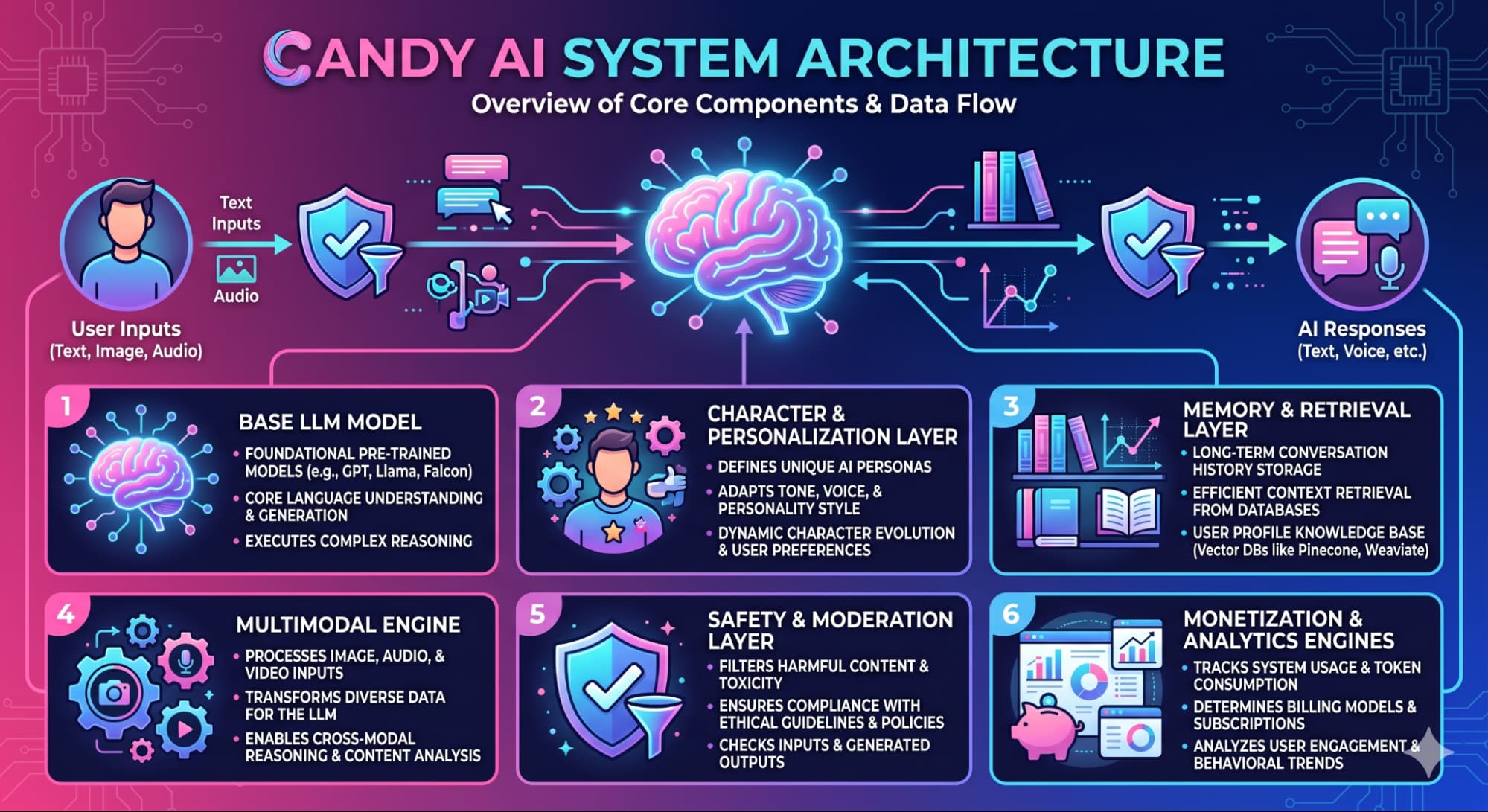
A production-ready Candy AI companion consists of a multi-layered architecture with different components, memory, a safety layer and data pipelines. The architecture is modular, optimized and scalable, rather than a monolithic design.
Key Architectural Components
- Base LLM model
- Character and personalization layer
- Memory and retrieval layer
- Multimodal engine
- Safety and moderation layer
- Monetization & analytics engines
These modules work asynchronously but share data via AI orchestration.
Candy AI Clone Tech Stack
Defining a robust tech stack is crucial for the success of your Candy AI clone platform. Choosing the right tech stack helps to build a performance-driven, scalable and secure platform.
Let’s take a look at the technology used in Candy AI clone:
1. Frontend Layer
The frontend includes the UI/UX conversational interface, character profiles, avatars, user dashboard, voice UI, smooth chat transitions, and monetization displays.
Technologies:
- React.js: It is a JavaScript library for building smooth and interactive user interfaces. React fits seamlessly into a modern tech stack thanks to its declarative, component-based architecture.
- Next.js: It is a powerful, open-source framework with built-in libraries for routing, optimization, data fetching, SSR, and code-splitting.
- React Native/Flutter (mobile): Cross-platform frameworks like React Native and Flutter enable developers to build iOS and Android apps from a single codebase.
2. Backend Infrastructure
This is where the real logic and data reside. It defines how you handle real-time requests, AI orchestration, payments and memory interactions.
Technologies:
- Node.js: It is ideal for real-time applications, fast execution and flexible API development needed for companion platforms.
- Django/Python with FastAPI framework: Django is a high-level Python framework for complex memory handling and ML-related tasks. FastAPI is a modern, lightweight Python framework for a high-performance API layer.
- AI Orchestration: The brain behind the human-like responses. An orchestrator like LangChain sends prompts to LLMs, routes requests to appropriate image, video and chat models and also coordinates memory and context pipelines.
3. Database
AI companion platforms store text chats, past events, user preferences, and even voice interactions. So, relying on traditional SQL-first databases with rigid data structures creates slow responses, complexity and unnecessary overhead.
Database layer includes:
- Redis (Short-term memory): Just like RAM, Redis stores recent chats, conversation threads and temporary context reducing the retrieval and response time.
- MongoDB (Long-term memory): Supports flexible data structures for storing user data such as past conversations, character details, behavioral patterns and communication style.
- PostgreSQL: Feature-rich, relational databases for storing user accounts, settings and session logs.
The layered database enables a consistent character personality for both text-based and multimodal responses, reducing the persona drifts.
4. AI & Machine Learning Layer
The AI layer is the core of the Candy AI clone, generating human-like responses. It coordinates with the character engine and personalization layer for context-aware and emotionally adaptive output.
| AI Layer | Model & Libraries |
|
Conversation Engine |
Proprietary Models (Restrictive): GPT-5.5, GPT-4, GPT-4o, Claude 3.5, Gemini 2.0 (for multimodal integrations)Open-Source Models (Suitable for NSFW companions): Hermes-3 Llama-3.1-8B, Yi-1.5-9B-Chat, Humanish-Roleplay-Llama-3.1-8B, OpenChat – 3.5-1210 (Hugging Face), Mistral |
| Voice Generation Models | ElevenLabs (TTS)
Whisper model(STT) |
| AI Libraries | Hugging Face and LangChain |
Open-Source vs Proprietary LLMs
| Comparison Aspect | Open-Source | Proprietary LLMs(like GPT-model) |
| Data Privacy | Self-hosted on private infrastructure providing complete control over data and privacy | Runs on vendor’s infrastructure raising security and privacy concerns |
| Performance | Rapidly improving with community support | High performance as it is trained on large datasets |
| Conversation Quality | Improving response quality requires fine-tuning | Consistent and accurate responses |
| Customization | Highly flexible and transparent | Rigid and limited customizations |
| Fine-Tuning | Easy to fine-tune and adapt as per business needs | Trained on private datasets; fine-tuning available to businesses through commercial channels |
| Cost | Free or available at low cost | High to moderate API usage costs and licensing fees Example: GPT-5.5 charges $5 per 1M tokens for input and $30 per 1M for output. |
5. Memory & Personalization Engine
It defines the character engine responsible for the person’s memory, personality and emotional intelligence.
Key aspects include:
- Personality Engine: Provides the AI persona’s specific personality traits, characteristics and conversational style. Includes an avatar, which is a core part of the character’s visual identity that users recognize the AI model with.
- Vector Databases: Pinecone, Chromadb store conversation embeddings for faster retrieval and similarity search.
- Emotional Module: Includes custom logic for capturing the user’s sentiment, emotional state and mood.
6. Real-Time Communication
Real-time chat is an inherent feature of AI companions. Traditional HTTP request-response mechanisms can cause latency issues that are not acceptable in AI chat conversations.
- WebSocket: Persistent and instant chat responses are ideal for handling concurrent users and reducing API calls.
7. Cloud Hosting & DevOps
Cloud services, CDN and autoscaling ensure a secure deployment and performance during peak traffic loads.
The deployment pipeline includes:
- Cloud Services: Google Cloud, AWS (EC2/ Lambda), offer scalable infrastructure and high performance.
- CDN Setup: Distributed server systems for fast media delivery, reduced latency, DDoS protection and caching. Cloudflare, Akamai, and Amazon CloudFront are commercial providers.
- Docker: Packages code and dependencies into containers to avoid dependency conflicts for LLMs, voice and image models.
- GPU: Cloud GPUs offer computation power for LLM inference, training AI models, and auto scaling. Recommended GPU types are NVIDIA GeForce RTX 4090 and cloud based GPU providers like AWS and Google Cloud.
8. Security & Authentication
User authorization, third-party verification tools, and session management grant secure and consistent user access.
- JWT/OAuth2.0: Used for secure and scalable user authentication.
- SSL/TLS: It secures data in transit and needs a separate encryption mechanism for stored data to avoid third-party access.
- AI Moderation: Hive Moderation, OpenAI Moderation API, Azure AI Content Safety , and Amazon Rekognition build an efficient, accurate and scalable moderation process.
- Age Verification: Jumio, SumSub, Yoti and Veriff enable age and identity verification, allowing only users over 18 years of age.
9. Payment Gateways & Monetization
Payment gateways handle user payments and ensure strict PCI-DSS compliance to avoid legal risks and penalties.
Here’s what you need to know:
- Payment gateways: Adult payment providers like CCBill, Epoch, Segpay, and Verotel handle high-risk transactions, reduce chargebacks and show high approval rates.
- Subscriptions: Primary revenue stream comes from monthly and annual subscriptions.
- Tokens: Includes wallet and token-based systems for in-platform purchases like custom avatars, voice and video interactions.
10. Admin & Analytics
Dashboards help to track user activity, engagement, monetization and manage account controls.
- Admin Panel: Built using Google Analytics & Mixpanel, providing a complete overview of platform usage, conversions, revenue,etc.
- User Analytics: Tracks daily active users, session length, churn rate,etc.
- AI Usage Tracking: Provides token usage, LLM conversation frequency, and cost per conversation.
Real Cost of Building Candy AI Clone
The cost to develop a Candy AI clone ranges from $15,000 to $150,000+ for custom development. The final cost depends on complexity, team location, LLM model selection, tech stack, and infrastructure costs. White-label Candy AI clone scripts by Fanso lower the MVP development cost to $9,000 and help to launch your platform within 1-2 weeks.
| Components | Estimated Development Cost |
| Discovery & Planning | $1,000 – $2,000 |
| Frontend | $3,000 – $8,000 |
| Backend Infrastructure | $5,000 – $20,000 |
| Figma Design Cost | $1,500 – $3000 |
| AI Model Selection & Training | $8,000 – $25,000 |
| Voice Integration | $4,000 – $12,000 |
| Image/ Video Generation | $5,000 – $15,000 |
| Subscription & Monetization Setup | $1,000 – $2,000 |
| Moderation & Security | $3,000 – $8,000 |
| Testing & QA | $2,000 – $5,000 |
| Total Development Costs | $33,500 – $100,000 (Mid-Advanced-level platform) |
Performance Benchmarks
Once your Candy AI clone is deployed, constant performance and engagement monitoring are essential.
Track the following KPI metrics:
- Response Latency: Fast response times for text, voice and video-based interactions.
- Concurrent Users: Manage hundreds of simultaneous user conversations.
- Conversational Depth: Ensure your AI companion recalls conversation history, key user details, and preferences.
- Daily Usage: Track the number of daily users, new users, churn, and conversions.
- Error Rates: This includes memory degradation, personality drifts, poor image quality and even repetitive loops.
Use Cases of Candy AI Clone
Candy AI clones can be used across several scenarios beyond adult entertainment, including:
- Mental Health & Emotional Support: Offer safe and judgment-free advice to people dealing with loneliness or anxiety.
- Productivity or Fitness Coach: A motivational coach or fitness motivator helps users to reach their goals.
- Elderly Companion: Basic companionship and social support for older adults to reduce isolation and stay connected.
Legal & Compliance Considerations of Candy AI Clone
Embedding the safety & compliance layer is deeply ingrained in the Candy AI development rather than being an afterthought.
Key legal concerns to build a secure companion are:
- Safety & Ethical Risks: Digital companions can generate harmful or biased responses. Implement guardrails, prompt injection detection, and bias auditing frameworks for safe responses.
- Privacy & Data Protection: AI chats collect sensitive personal information from users, which is not stored and handled properly. The mitigation approach includes data minimization, encrypted fields, and transparent data collection practices.
- Moderation & Guardrails: Content moderation is crucial to rule out violence, illegal content or inappropriate language in AI interactions. Introduce human-in-the-loop (HITL), soft moderation scores, and tiered response rewriting.
- AI-Generated CSAM & Minor Protection: AI Child Sexual Abuse Material threat addresses sexually explicit images or realistic videos of children generated by AI. Robust safeguards include age verification, prompt filtering, human review and escalation.
- Intellectual Property & Rights of Publicity: Ensure your AI models are trained on fully licensed, open source datasets. Rights of publicity protects the commercial use of a person’s face, voice, traits or any other identity aspects. On the other hand, copyright protects original creative work like images, videos, and character artwork. Your platform policy must state that users have essential rights on uploaded images or content and infringement is prohibited.
Conclusion
If you’re building a Candy AI clone, you don’t need to choose the same technologies and frameworks. Evaluate your niche, requirements, development team’s expertise and budget. Moreover, using the same frameworks and technologies won’t guarantee success.
If you’re struggling to choose the right tech stack for Candy AI clone, our team of developers and support engineers can help you to choose the right technology as per your business needs and sustain long-term growth. Contact Fanso today to start, iterate and succeed early with our white-label Candy AI clone!
Further Reading:
FAQs-Related to Candy AI Clone Tech Stack
1. Are open-source LLM models more suitable than proprietary LLMs?
Open-source LLM models like Llama, Mistral and Hermes offer more flexibility, data control and customization. Proprietary LLMs like GPT models are restrictive, have high variable costs, security concerns, and are less suitable for NSFW content.
2. Which databases are best for Candy AI clone?
Databases like Redis, MongoDB, and PostgreSQL are recommended for Candy AI clones.
3. How is the memory & personalization layer implemented for candy AI clones?
Candy AI clone uses vector databases like Pinecone to store conversation embeddings. This includes user preferences, past conversations, personal details and even specific conversational tones for more tailored and contextual responses.
4. How much does it cost to build a Candy AI clone?
The cost of building a Candy AI clone is $15,000 to $30,000 for an MVP platform and $30,000 to $60,000 for an advanced platform.
5. How to manage personality drifts in Candy AI clone?
Define explicit personality boundaries and constraints. Employ effective controls like periodic decay, switch to different AI models for complex needs, and provide a few-shot prompt examples.
6. Is it possible to build Candy AI clone with white-label clone scripts?
Yes, white-label Candy AI clone by Fanso helps you launch your MVP platform at $9000 within 1-2 weeks.