
The rise of AI companion platforms and the way the audience receives them clearly tells us that this is an untapped business opportunity waiting to be conquered. This is because of the nature of AI companion platforms, which deliver entertainment, personalization, and fantasy, altogether.
Among the many AI companion platforms, Candy AI has gained significant traction by giving users customizable virtual companions, emotional interaction, and personalized responses. The enormous success Candy AI has achieved has naturally sparked interest among entrepreneurs and businesses looking to build similar platforms, prompting a very practical question: What is the cost to build a Candy AI clone?
In this guide, we will break down the cost of building a Candy AI clone, explore the factors that influence it, and provide realistic estimates to help plan the investment.
What is Candy AI and How Does the Platform Work?
If you’re planning to build an AI companion platform like Candy AI, understanding how the platform works is important because it directly influences the cost of building a Candy AI clone.
Candy AI is an AI-powered virtual companion platform launched in 2023 that allows users to interact with human-like AI chatbots. Candy AI boasts emotionally responsive digital companions that users can customize based on personality, their interests, and a preferred communication style.

Instead of one-time conversations, Candy AI’s virtual companions can indulge in continuous, contextual, and personalized interactions. The best part is that they can also generate media to make the conversation more lively. The elements of personalization, fantasy, and continuous availability have made Candy AI a great success in recent years.
Typically, users start with limited access and then pay a premium to access the advanced features such as customization, media generation, and prolonged conversations. In short, that’s how Candy AI works and generates revenue.
Why Businesses Are Building Candy AI Clones in 2026?
The answer is simple: businesses want to capitalize on the highly booming and lucrative AI companion market. Here are the key reasons why businesses are building Candy AI clones.
- High Profits: In 2024, the worldwide AI companion market was valued at $28.19 billion and is projected to grow to $1.4 trillion by 2030. Candy AI also generates $25 million in annual revenue, highlighting the profitability of the business.
- Standard Development Playbook: When you are planning to build Candy AI-style clones, you don’t need to begin developing the model from scratch; instead, you can simply replicate it, making the launch of the business even simpler.
- Faster Development and Customization: With ready-to-use white-label solutions, Candy AI clones can be built within a matter of days rather than months. Platforms such as Fanso.io and similar solutions provide pre-built infrastructure and essential features, enabling businesses to launch efficiently while reducing development time and complexity.
- Large Revenue Models: The primary methods of revenue are subscriptions backed by upgrades and one-time purchases. Combined, it can increase user retention, thereby increasing revenue.
- Global Market Potential: Businesses can launch the platform in one region and eventually expand it into additional countries, leading to a massive worldwide customer base and generating increased revenue opportunities.
Beyond this, there’s the opportunity to target niche markets and specialized audiences. All these are the reasons why businesses are building Candy AI clone platforms.
Core Features Required in a Candy AI Clone
Candy AI is more than just a chat interface. It is a virtual companion platform with robust features, powered by AI, making the platform what it is. Below are the essential features every Candy AI–style platform should include.
1. AI-Powered Chat System
This is the core component of the platform, enabling users to interact with virtual companions and receive personalized, context-aware responses. The LLM model you are integrating can be a game-changer for your platform, as it determines conversation quality, response times, conversational memory, etc.
It should also be capable of handling multiple users simultaneously without delays or performance issues.
2. Character Customization and Personalization
Customization is one of the main reasons users stay engaged and visit AI companion platforms repeatedly. While some companion platforms allow users to create multiple companions, the baseline should be modifying personality traits, communication style, interests, and visual appearance.
3. Real-Time Messaging and Notification System
Users start engaging with a virtual companion, expecting conversations to happen instantly and without interruptions. Anything else can cause frustration. To achieve this, the platform requires a stable backend infrastructure capable of managing thousands of interactions simultaneously.
4. Secure User Authentication and Data Protection
For continuous usage, users need to trust that their data is protected and stored securely. This includes login systems, encrypted data transmission, and privacy controls. Investing in strong security systems helps protect the platform from data breaches and increases trust.
5. Subscription and Payment Integration
The platform runs on subscription-based revenue models. You need to connect the platform to payment gateways, manage billing cycles, and handle subscriptions. Your platform should also support multiple payment methods like credit cards, wallets, and country-wise payment methods.
6. Content Moderation and Safety Controls
A safe and controlled environment is non-negotiable for users. Features like filters, flagging & reporting, and moderation tools make your AI companion platforms safe to use.
7. Analytics and Performance Monitoring
These tools help businesses understand how their users behave and tweak the platform accordingly. Gauging metrics like subscriptions, engagement, and retention with dashboards allows businesses to refine features, improve retention, and grow with calculated strategies.
8. A Memory that Remembers
Persistent memory is an important factor in an AI companion app because it keeps records about the past interactions with the user, including preferences and other details, enhancing user experience and increasing engagement and usage.
9. NSFW Toggle and Content Preferences
Though AI companions are quite popular, the inclusion of the option to have an NSFW toggle in these applications makes it easier to provide users with content that suits their needs. This ensures compliance with policy guidelines and regulations governing the platforms.
10. AI Image Creation
AI image creation gives users the ability to personalize their visual representations or create personalized companions. This adds more value to the overall user experience by allowing them to have personalized visual companions while creating media on the go.
11. Live Video or Interaction Mode
Live video mode enables users to have interactions with their AI companions via videos, allowing users to have an exciting and immersive experience that allows them to interact more naturally with their digital companions.
12. Reels or Feeds-Based User Interface
Reels or feeds-based UI provides users with an option to see and scroll through various images and videos generated by AI companions. This feature helps improve user experience because people usually tend to spend a lot of time going through reels of content.
Candy AI Clone Development Cost Breakdown
How much does it cost to create a Candy AI clone app depends on how complex the platform is and the features you’ve decided on. A basic functional platform typically requires an investment starting from around $10,000 to $15,000, but a highly sophisticated platform can cost more than $50,000 and sometimes even $100,000.
Understanding the cost breakdown will help you decide what’s important for your platform and avoid unexpected costs during the development phase. Below is a realistic breakdown of the cost to build a Candy AI clone app.
1. UI/UX Design Cost
User experience is one of the key factors affecting the cost of building a candy AI clone. A clean, user-intuitive, and responsive design will help users stay longer on the website. The overall design process includes mobile responsiveness, visual design, web optimization, and more.
This usually involves a design team with UI/UX experts, and the estimated cost is around $2,000 – $6,000.
2. Frontend Development Cost
The user-facing side of the application should have features like the chat interface, profile management features, subscription pages, AI companion profiles, and more. While this sounds simple, the real challenge is getting the responsiveness, animation, and real-time interaction right.
The estimated cost to build a front-end interface, including all these and beyond, costs around $5,000 to $12,000.
3. Backend Development Cost
Functions like conversations, media generation, user data management, etc are taken care of in the backend. A strong backend ensures your AI companion platform runs smoothly while handling a large volume of interactions. The estimated cost is $7,000 – $18,000.
4. AI Model Integration Cost
This part involved connecting LLMs to your platform. Generally, third-party AI APIs are integrated for their cost-efficiency factor. AI costs depend on the usage and the level of interactions on your platform and can easily cost up to $4,000 to $15,000.
5. Payment Gateway Integration Cost
Your platform needs a reliable payment gateway service provider to manage billing cycles while ensuring secure transactions. Due to the sensitive nature of the platform, choose a payment services provider that supports adult-service transactions. The monthly cost can range between $1500 – $4000.
6. Cost Associated With LLM Usage
LLMs provide live replies to prompts by users. As such, the computing power of the models is consumed when handling each message. It becomes one of the greatest recurring expenses for an AI companion platform due to user activity, the duration of chats, and the number of users.
The average cost associated with the use of LLMs falls within the range of $1,500 – $12,000 per month.
7. Cost of Memory and Vector Databases
In order to offer personalized and consistent conversations, there needs to be a memory system storing preferences and chat histories of users. To do that, one can opt for vector databases or large-scale storage solutions. The estimated cost for memory systems ranges from $400 – $3,500 per month, depending on storage size and retrieval frequency.
8. Speech-to-Text and Text-to-Speech System
The former translates voice input to text, while the latter synthesizes natural-sounding voice responses to queries. Both systems are usually charged based on time used and frequency of requests. The expected cost for voice-processing functionality services is estimated at $600 – $6,000 monthly.
9. AI Avatar and Image Creation System Cost
AI avatar generation and image creation features require GPU-intensive processing to render visuals and media content. These features significantly enhance engagement but also increase infrastructure usage, especially when users frequently generate images or visual companions.
The estimated cost for AI avatar and image generation ranges from $800 – $7,000 per month, depending on generation volume and rendering complexity.
10. Third-Party API Integration Cost
When building an AI companion app, it requires integration with multiple third-party APIs, such as messaging APIs, email services, analytics platforms, and more. The estimated cost for third-party APIs typically ranges from $250 – $2,500 per month, depending on the number of integrations and usage levels.
11. Domain Name, SSL Certificate, and Hosting
Every platform requires a domain name, an SSL certificate, and secure hosting. While the cost of the domain name and an SSL certificate remains static, as traffic increases, hosting and compute resources, including GPU instances, become critical cost drivers.
The estimated cost for domain, SSL, hosting, and basic infrastructure ranges from $300 – $3,000 per month, depending on traffic and server configuration.
All these together offer a realistic estimate for understanding the true cost of launching and running a Candy AI clone platform and it can vary depending on complexity and scale of the platform.
How to Reduce the Cost of Building a Candy AI Clone?
While virtual companion platforms can be a lucrative business, the investment costs can mount up quickly, making it difficult for some, especially for startups, who look to launch faster while reducing the risk and increasing profits.
With the advancement of tech, businesses have multiple ways to reduce development costs without compromising the vision. One such way is to use white-label solutions that significantly shorten development timelines. These ready-made solutions come pre-built with UI/UX, and necessary tech integrations, and the frontend & backend framework, allowing you to launch your platform faster and focus on growth and user acquisition.
One such solution is Fanso.io, a white-label creator marketplace software provider that allows entrepreneurs to build and launch their own subscription-based content platforms like Candy AI, OnlyFans, Patreon, and more.
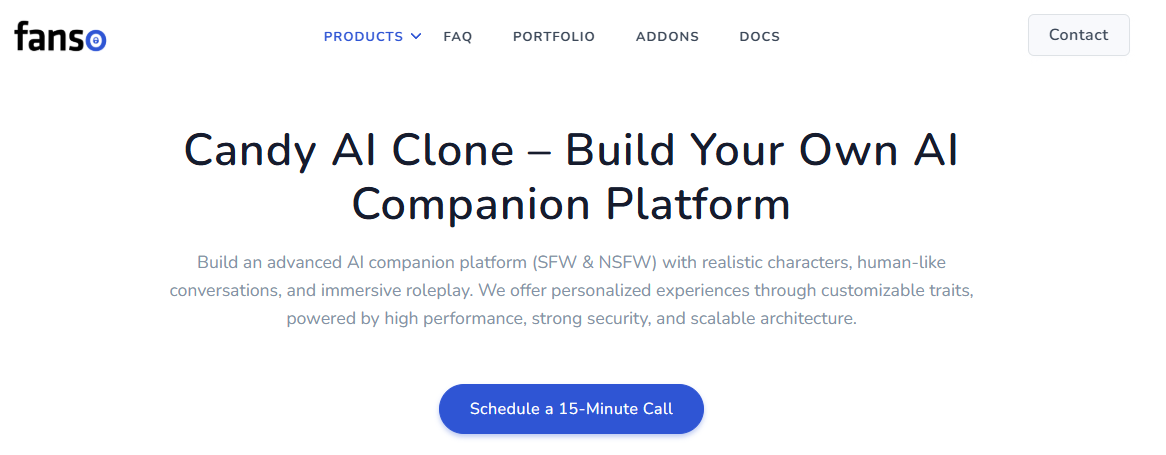
Fanso’s Candy AI clone script comes with all the necessary features, like AI companions, AI image generation, custom AI characters, digital wallet, admin dashboard, payment transaction gateways, and more.
Since everything is pre-built, the development cost is way less than building it from scratch, making white-label solutions an ideal alternative to the traditional approach.
Technology Stack Required to Build a Candy Clone
We talked about the different aspects of building a Candy AI clone. Here’s the tech needed to crack it.
| Frontend Technologies | React, Next.js, Vue, React Native, Flutter |
| Backend Technologies | Node.js, Python (FastAPI) |
| Databases | PostgreSQL, MongoDB, Redis |
| AI Models | OpenAI, Claude, Gemini, LLaMA |
| Image & Voice | Stable Diffusion, ElevenLabs, Whisper |
| Cloud | AWS, Google Cloud, Azure |
| Security | OAuth 2.0, SSL/TLS |
That’s a high-level overview of the tech stack required to build a Candy AI clone app. You can choose what works best for you and get started accordingly. Fanso’s Candy AI clone script is built using the tech stack mentioned above, making it a robust and reliable Candy AI clone solution.
Development Timeline for a Candy AI Clone
Development usually varies depending on the approach businesses choose. Here is a quick breakdown of the development timeline between the traditional approach and ready-made solutions.
1. Traditional Development Approach
The entire platform will be developed from the ground up, offering maximum flexibility and customization. Here’s a quick timeline for building a Candy AI clone using this approach.
- The planning phase: 1 to 2 weeks
- UI/UX design: 2 to 5 weeks
- Frontend & backend development: 5 to 8 weeks
- AI integration & testing: 1 to 3 weeks
- Deployment & optimization: 1 to 2 weeks
The total estimated development timeline is around 4 to 6 months.
2. White-Label or Ready-Made Solution Approach
The easier alternative, the white-label development approach, uses pre-built infrastructure, making development and launch faster.
- Setup & configuration: 2 to 5 days
- Branding & customization: 3 to 5 days
- Payment & system integration: 1 to 3 days
- Testing & deployment: 1 to 4 days
The total estimated development timeline is around 1 to 3 weeks. The latter approach is ideal for startups that are low in investment and want to launch quickly and validate their idea.
Monetization Models for a Candy AI Clone
The highly lucrative opportunity is what makes businesses pursue a Candy AI clone app. Here are the top monetization models you can add to your AI companion platform.
1. Subscription-based Revenue Model
This is the primary revenue model for your platform. Users pay a recurring monthly or yearly fee to use the platform continuously and access its premium features. This model is most important because it provides a month-on-month predictable revenue for the business.
Here’s a sample pricing model:
- Basic Plan: $8 to $12 per month
- Premium Plan: $18 to $28 per month
- Annual Plan: 10% to 20% discount
2. Pay-Per-Use or Credit-Based Model
For users who don’t wish to go for a subscription, the credit-based model works well. Instead of a fixed subscription, users purchase credits to access premium features for a certain period of time. It could be for generating images, messaging, or voice conversations.
3. In-App Purchases and Add-On Features
This works very differently from a subscription or a credit-based system. Users can buy exclusive add-ons from the platform for an additional amount beyond their regular subscription.
This can help increase average revenue per user (ARPU) without requiring major infrastructure changes.
4. Advertising and Affiliate Revenue
While this should not be treated as the primary revenue stream, it can add more to your monthly revenue. The common advertising options include sponsored content, affiliate tie-ups, and display ads.
On the other hand, users expect a clean experience when they visit your website. Try to find the right balance between that and the sponsored content.
Having a diverse monetization strategy for your AI companion platform is important because it can maximize profitability while safeguarding the platform’s success. Make sure that the chosen monetization model also aligns with the platform’s target audience and your growth goals.
Conclusion
Building an AI companion platform like Candy AI is no longer difficult, especially with the availability of white-label solutions like Fanso.io. In this guide, we’ve discussed the different factors that influence the cost to build a Candy clone AI platform, along with a realistic estimate.
Knowing the estimates upfront helps businesses to plan accordingly before they commit to building the platform. As for the AI companion market, there’s huge potential, and the competitors are very few at this stage.
With the right technology stack and ideal business approach, launching a Candy AI-style platform and succeeding at it is highly achievable and rewarding too!
Frequently Asked Questions
1. How much will it cost to create a Candy AI clone app in 2026?
The total cost depends on the complexity, features, and other characteristics you tend to include in the Candy AI clone app. The base version of the platform can be developed for as little as $10,000, while the more advanced version with customized features, integration of AI technologies, and scalable infrastructure can easily cost up to $50,000.
2. How much time does it take to create and launch a Candy AI clone platform?
It takes about 4 to 6 months to develop the platform from scratch, taking into account planning, design, development, integration of AI, and deployment. However, choosing a white-label can save a lot of time, reducing the period of development and launch to one to three weeks.
3. Which factors affect the price of building a Candy AI clone platform?
Multiple factors influence the final price for developing the platform. In addition to planning, designing, developing, testing, and deploying, you will need to spend some funds on the integration of the AI model, frontend and backend development, user interface, and infrastructure setup requirements.
4. How can businesses reduce the cost of building a Candy AI clone platform?
Businesses can reduce development costs by using white-label solutions that come with pre-built infrastructure, core features, and essential integrations. This approach reduces development time, lowers technical complexity, and allows businesses to launch faster while focusing on user acquisition and platform growth.