
TL;DR: How to Build an App Like Chai AI
- To build an app like Chai AI, focus on the roleplay features that shape the user experience, including AI characters, character creation, real-time conversations, memory, character discovery, moderation, subscriptions, credits, and admin controls.
- The development process includes defining the target audience and roleplay format, planning the MVP and monetization model, building the main user journeys, testing AI responses and payment flows, and improving the platform using user data after launch.
- For AI roleplay chatbot development, select the right combination of frontend and backend technology, LLMs, memory storage, real-time messaging, cloud infrastructure, payment processing, media services, and content moderation tools.
- The cost to build an app like Chai AI can be $15,000-$30,000 for a basic text-based MVP and $60,000-$150,000+ for an advanced platform with voice, image generation, scalable infrastructure, and deeper personalization.
AI roleplay apps let users interact with fictional characters through ongoing, responsive conversations. Creating a platform like Chai AI involves more than connecting a chat interface to a language model. It requires characters with defined personalities, conversations that retain relevant context, and tools that help users discover, interact with, and return to their favorite characters.
The business model also shapes development decisions. Subscription plans, credit packs for higher-cost interactions, and paid media features must work with the app’s access controls and billing system. These requirements form part of the wider process of building an AI companion platform, from designing the user experience to establishing the technical foundation.
This article covers how Chai AI works, the core features of a Chai AI-like app, the technology stack, the development process, and the estimated cost.
How Does Chai AI Work?
Chai AI combines user-created characters with conversational AI to support personalized roleplay chats. Users can browse existing characters, start conversations, or create their own bots. Each character has a distinct identity and personality that helps shape the interaction.
AI Characters and Personas
Users can create characters by defining their identity, personality, and conversational style. They can also write an opening message to establish how a character starts a conversation. Creators can choose to make their bots public or private, allowing them to share characters with the wider community or keep them for personal use.
Conversations and AI Response Generation
When a user sends a message, Chai’s AI models generate a response based on the conversation and selected character. According to Chai, its platform uses in-house developed large language models (LLMs) and its own GPU infrastructure to support conversational AI at scale. This infrastructure is designed to serve a large library of user-created characters.
Character Discovery and User Feedback
Chai allows users to discover characters created by other members of the community. During conversations, users can also adjust how a character responds, edit bot messages, or request a new response. These controls give users more flexibility over the direction of a roleplay conversation.
Together, character creation, AI-generated responses, and character discovery form the foundation of Chai’s platform. Building similar functionality requires an AI companion app tech stack that supports model integration, conversation management, and real-time interactions.
Essential Features to Build an App Like Chai AI
An AI roleplay platform needs features that support character interaction, user engagement, and business operations. The initial version can focus on the core experience, with advanced capabilities added as the platform grows.
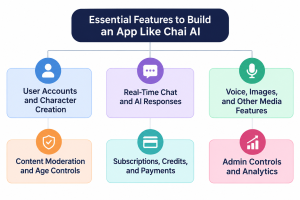
1. User Accounts and Character Creation
User accounts let people manage their profiles, conversations, preferences, and subscriptions. Registration can support email and social sign-in, while profile settings can include display names, language preferences, and privacy controls.
A character builder should provide fields for names, avatars, greetings, personalities, scenarios, and communication styles. Public and private visibility options allow creators to decide whether their characters are available to the wider community.
2. Real-Time Chat and AI Responses
The chat interface should make conversations easy to follow, with clear message layouts, response-generation indicators, and access to previous chats. Useful controls include editing messages, retrying responses, deleting conversations, and reporting inappropriate interactions.
The experience should remain responsive during longer conversations and provide clear feedback when a message fails to send or receive a response.
3. Voice, Images, and Other Media Features
Beyond text conversations, voice and visual features can give users additional ways to interact with characters. These may include text-to-speech, voice messages, live voice conversations, character portraits, and AI-generated scene images.
Businesses can introduce these capabilities based on their target audience and product scope. Since media features can increase operating costs, access may be included in premium plans or managed through usage-based credits.
4. Content Moderation and Age Controls
Moderation tools help manage inappropriate user activity, character descriptions, uploaded media, and AI-generated responses. Reporting and blocking options also allow users to flag content or interactions that violate platform rules.
Age restrictions and content controls should reflect the app’s intended audience and the markets in which it operates. Different content moderation tools for AI companion platforms can help review text and media, but the platform also needs clear policies and a process for handling reports.
5. Subscriptions, Credits, and Payments
A flexible payment system can support recurring subscriptions, one-time purchases, and credit packs. Subscriptions may unlock premium characters or additional access, while credits can be used for selected paid interactions and media features.
Users should be able to view their plans, remaining credits, renewal dates, and transaction history. The platform should also support cancellations, failed payments, refunds, and subscription changes.
6. Admin Controls and Analytics
Administrators need tools to manage user accounts, review published characters, handle reports, and oversee subscriptions and platform activity. Access permissions can help separate routine support tasks from more sensitive administrative functions.
Analytics can track active users, popular characters, conversation activity, subscription conversions, and moderation reports. These metrics help businesses understand user behavior and identify areas that need improvement.
Technology Stack for AI Roleplay Chatbot Development
The technology stack for an AI roleplay app connects the user interface, backend services, AI models, and data systems. These components work together to support responsive conversations, consistent character behavior, and reliable platform performance.
1. Frontend, Backend, and Real-Time Messaging
The frontend can use React or Next.js for web applications, or Flutter and React Native for mobile apps. The backend, built with technologies such as Node.js, Python, or Laravel, manages application logic and communication between services.
WebSockets support real-time messaging by delivering AI responses as they are generated. This keeps conversations responsive without making users wait for the full response.
2. AI Models, Memory, and Data Storage
The AI layer can use third-party large language model (LLM) APIs or self-hosted open-source models. The choice depends on response quality, latency, operating costs, and content requirements. Model selection should also account for character consistency and the ability to maintain conversation context.
PostgreSQL or MySQL can store structured information such as user profiles, character settings, and payment records. A vector database can retrieve relevant details from earlier conversations to support long-term memory.
3. Security, Payments, and Infrastructure
Cloud services such as AWS, Google Cloud, or Microsoft Azure can host the application and its supporting systems. Object storage can store media files, while caching and background job queues handle repeated requests and time-consuming tasks.
The platform should also use encrypted data transmission, access controls, rate limits, and regular backups. Payment integrations need secure checkout and webhook handling to update subscriptions or credit balances after successful transactions.
Steps to Develop an App Like Chai AI
Choosing the right company to build an AI companion app like Chai AI starts with clear product decisions. Define the roleplay experience and core requirements first, then select a development partner and technology stack that can support the platform as it grows.
1. Define the Audience and Roleplay Experience
Start by defining the target audience and the type of interaction the app will provide. A platform built around interactive fiction needs different characters, discovery features, and conversation rules from one focused on daily companionship or language practice.
This decision should shape the character catalog, AI response style, safety boundaries, and monetization model. It also helps identify which capabilities are essential for launch and which can remain on the product roadmap.
2. Plan the MVP and Monetization Model
The first version should focus on the interactions that encourage users to return. A focused MVP may include user accounts, an initial character catalog, text-based conversations, basic memory, moderation controls, and a simple subscription or credit model.
Not every capability needs to be available at launch. Introduce voice calls, image generation, public character publishing, and advanced recommendations in later releases. However, define the payment model early because subscriptions and credits affect account permissions, checkout flows, and usage tracking.
3. Build, Test, and Moderate the App
Start development with the main user journey, from account creation and character discovery to the first conversation, payment, and return visits. Testing should evaluate conversational quality alongside the app’s operational behavior.
For example, test how characters respond during longer conversations, what happens when an AI model request fails, whether credits are deducted correctly, and whether canceled subscriptions trigger the appropriate access changes. Moderation testing should also cover realistic prompts, generated responses, and edge cases that may not appear during routine feature testing.
4. Launch and Improve From User Data
After launch, product analytics can show where users drop off in onboarding, which characters drive repeat conversations, whether subscriptions convert, and which features generate support requests.
Use these findings to prioritize improvements. The character catalog may need better discovery filters, subscription plans may need clearer usage limits, or the app may need more reliable memory before introducing additional media features. This approach helps the product evolve based on observed user behavior rather than assumptions.
Cost to Build an App Like Chai AI
The cost of building an app like Chai AI depends on the product’s scope, AI capabilities, and expected user activity. A basic text-based roleplay app requires less investment than a platform with long-term memory, voice conversations, image generation, and custom AI infrastructure.
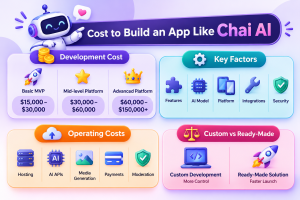
The budget should cover both initial development and the services required to operate the platform after launch. The following estimates provide a starting point for planning.
1. Estimated Development Cost
For a custom-built AI roleplay platform, development costs can vary across three levels:
| Development level | Typical scope | Estimated cost |
| Basic MVP | User accounts, character creation, text-based AI chat, basic memory, and moderation | $15,000- $30,000 |
| Mid-level platform | Advanced character personalization, improved memory, subscriptions, image generation, and expanded moderation | $30,000-60,000 |
| Advanced platform | Voice conversations, image and video generation, custom AI system, advanced analytics, and dedicated infrastructure | $60,000-$150,000+ |
These figures are indicative planning estimates, not fixed development quotes. The final budget depends on the required features, integrations, customization, and infrastructure.
2. Factors That Influence Development Cost
The initial development budget depends on several technical and product decisions:
- Feature complexity: Character creation and text-based conversations require less development than advanced memory, voice interactions, and media generation.
- AI model selection: Integrating an existing LLM API generally requires less initial infrastructure work than hosting and maintaining custom models. Model performance, response latency, and expected usage also influence the choice.
- Platform support: A web application typically requires less development work than a product that also supports separate iOS and Android applications.
- Customization and integrations: Custom recommendation systems, payment gateways, and moderation services add implementation and testing requirements.
- Infrastructure and security: Database architecture, access controls, data protection, and media handling affect the technical work required to prepare the platform for launch.
3. Post-Launch and Operating Costs
After launch, the platform needs recurring services and maintenance to keep conversations responsive and the user experience reliable. These expenses typically include:
- AI API usage: Model providers charge based on usage, often through input and output tokens. For example, OpenAI API pricing varies by model and processing type.
- Hosting and infrastructure: Cloud servers, databases, storage, and bandwidth costs depend on platform activity.
- Media generation and voice services: Image generation, speech synthesis, and voice conversations may require separate APIs or computing resources.
- Moderation and maintenance: Content review services, bug fixes, security updates, and technical support contribute to recurring expenses.
- Payment processing: Transaction fees apply to subscription payments and credit purchases.
These expenses can increase as the number of users and conversations grows. Businesses should estimate recurring costs using expected usage, including the volume of AI requests and media generated.
4. Custom Development vs. Ready-Made Solutions
Custom development gives businesses greater control over the platform’s architecture, features, and user experience. However, it usually requires a larger initial investment and a longer development timeline.
A ready-made solution can reduce development time because its core functionality is already available. It may suit businesses that want to launch sooner without building every feature from scratch. However, customization, AI integrations, hosting, and ongoing operating expenses still need to be included in the budget.
The choice depends on the required level of customization, available budget, and time to market. A ready-made platform may suit businesses testing an initial idea, while specialized requirements may call for custom development.
Final Thoughts
Building an app like Chai AI requires more than integrating an AI model into a chat interface. Character creation, conversational quality, memory, discovery, moderation, and monetization all contribute to the overall experience. Defining these requirements early helps businesses set a realistic development scope and budget.
Fanso provides a customizable foundation for launching an AI roleplay platform with character chat, subscriptions, and credits. Businesses can use this foundation to shape the product around their audience and feature requirements. Discuss an AI roleplay app project with Fanso.io to explore the available development approach.
FAQs About Building an App Like Chai AI
1. How much does it cost to build an app like Chai AI?
Building an app like Chai AI can cost between $15,000 and $150,000+, depending on its features and technical complexity. A basic MVP may cost $15,000-$30,000, a mid-level platform 30,000–60,000, and an advanced platform $60,000-$150,000+. These are indicative planning estimates, not fixed development quotes.
2. Which AI model is best for AI roleplay chatbot development?
There is no single best AI model for every roleplay app. Businesses can use third-party large language model (LLM) APIs or self-hosted open-source models. The choice depends on response quality, latency, operating costs, content requirements, and the model’s ability to maintain character consistency and conversation context.
3. How do apps like Chai AI make money?
AI roleplay apps can generate revenue through recurring subscriptions, one-time purchases, and credit packs. Subscriptions can unlock premium characters or additional access, while credits can cover paid interactions and media features such as image generation or voice services.
4. Can a Chai AI clone app include NSFW conversations?
A Chai AI-like app can be designed with content settings that support its intended audience and business model. However, NSFW conversations require appropriate age restrictions, content moderation, reporting tools, and clear platform policies. Businesses must also check the requirements of their AI model providers and the markets in which they operate.