TL;DR
- DreamGF clone development starts from around $1,500 for a ready-made solution, while custom development can reach $50,000-$120,000+ depending on the scope.
- AI chat, memory, character creation, image and video generation, voice, payments, and moderation are the main features that affect the development cost.
- Custom AI architecture, mobile apps, multiple third-party integrations, and dedicated infrastructure can increase the budget significantly.
- Post-launch costs include AI APIs, media generation, hosting, payment processing, moderation, and maintenance.
Building a DreamGF clone involves more than adding an AI chatbot to a website. The cost changes significantly when the product includes AI character creation, persistent memory, roleplay, image and video generation, voice interactions, subscriptions, credit-based usage, moderation, and an admin system.
The final development cost depends on the features you need, the level of AI customization, the platforms you support, and the integrations required to run these systems. Advanced capabilities such as long-term memory, real-time AI calls, custom AI architecture, and dedicated infrastructure can add considerably to the development scope.
This guide breaks down the DreamGF clone app development cost by feature, explains the factors that affect the estimate, and covers the ongoing costs of running the platform post-launch.
DreamGF Clone App Features and Development Cost
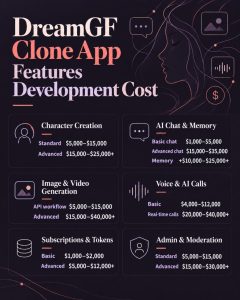
The feature set has a direct effect on the development of a DreamGF-style app, which requires separate systems for character configuration, AI conversations, memory, media generation, voice, monetization, and administration. The figures below are component-level planning estimates, not a project quote. They should not be added together because several features share authentication, backend services, databases, AI infrastructure, and testing
AI Character Creation and Customization
The character system determines how much control users have over the companions they create. A basic implementation may let users choose a name, appearance, gender, personality traits, and interests. A more advanced system can generate characters from detailed prompts and connect those attributes to the character’s conversational behaviour, appearance, voice, and memory.
A typical development range is $5,000-$15,000 for a standard character creation and customization system. The cost increases when character attributes need to influence multiple parts of the product, such as chat behaviour, generated images, voice output, and long-term memory. Advanced persona generation and character-specific AI logic can push the cost to $15,000-$25,000+.
AI Chat, Roleplay, and Memory
Text conversation is relatively straightforward when the platform only sends prompts to an LLM and displays the response. DreamGF-style roleplay becomes more complex when conversations need to maintain a defined personality, relationship context, conversation history, and long-term user preferences.
A basic AI chat implementation can cost around $1,000-$5,000. An advanced conversational system with personality controls, roleplay logic, model routing, and supporting backend services can reach $15,000-$35,000.
Persistent memory is a separate engineering layer. Storing conversation history is not the same as useful memory; the system needs to identify relevant information, retrieve it at the right time, and provide it to the model without unnecessarily increasing context size. A dedicated memory layer can add roughly $10,000-$25,000+, depending on the retrieval architecture and level of personalization.
AI Image and Video Generation
Image generation requires more than connecting an image API. The application needs prompt handling, generation requests, result processing, media storage, delivery, usage limits, and safeguards around generated content. Video generation adds longer processing times, larger files, and higher infrastructure requirements.
An API-based image-generation workflow can typically require $5,000-$15,000 in development. More advanced image workflows or custom generation infrastructure can push this toward $15,000-$40,000+.
Budget video generation separately because it adds processing and storage requirements. The final cost depends heavily on whether the platform uses an external video-generation API or operates its own generation infrastructure.
Voice Messages and AI Phone Calls
Voice messages require text-to-speech integration, audio generation, storage, playback, and usage controls. Real-time AI calls require a larger architecture covering speech-to-text, text-to-speech, real-time communication, call sessions, interruption handling, and audio processing.
Basic voice functionality can cost around $4,000-$12,000. A real-time AI calling system can increase the development scope to about $ 20,000–$40,000+.
Subscriptions, Tokens, and Payment Integration
A DreamGF-style monetization system may combine recurring subscriptions with credits or tokens that users spend on premium AI actions. The backend therefore needs subscription management, credit balances, transaction records, usage deductions, payment processing, and controls for different pricing plans.
Basic payment and subscription integration can start around $1,000-$2,000 when the platform only requires standard plans and a single payment gateway. A more advanced credit-based system with token packs, usage tracking, multiple payment flows, and premium AI actions can require approximately $5,000-$12,000+.
Payment processor fees are separate from development costs and depend on the processor, transaction volume, card type, and region.
Admin Dashboard, Moderation, and User Management
The admin system controls the operational side of the platform. Depending on the product, administrators may need to manage users, subscriptions, credits, characters, AI providers, generated media, reports, moderation rules, and platform settings.
A standard admin and moderation system can cost around $5,000-$15,000. An advanced setup can reach $15,000-$30,000+ when it includes automated content moderation, age verification, detailed audit logs, human-review workflows, advanced reporting, role-based admin access, and more extensive security controls.
The cost of building an AI companion platform like DreamGF depends on how these systems are designed and integrated. These are feature-level estimates, not six separate bills. A custom project shares infrastructure and engineering work across multiple features, so the individual ranges should not be added together to calculate the total development cost.
Factors That Affect DreamGF Clone Development Cost
The feature list provides only part of a DreamGF clone development estimate. The final budget also depends on the architecture behind those features, the platforms being supported, the number of external services involved, and the level of control required over AI, security, and infrastructure.
Platform and Device Support
Platform scope directly affects the amount of development and testing required. A web-based DreamGF clone can use one primary application layer, while adding iOS and Android introduces separate platform requirements for subscriptions, notifications, media access, microphone permissions, background behaviour, and device compatibility.
This becomes more significant for features such as voice calls and AI-generated media. A voice workflow that works in a browser may require different permission handling, audio-session management, and interruption behaviour on mobile devices. Subscription functionality can also require platform-specific implementation when purchases are processed through mobile app stores.
As a result, moving from a web-only product to web plus mobile is not simply a UI adaptation. It expands the frontend scope, integration work, QA coverage, and post-launch maintenance.
AI Model Selection and Architecture
The AI architecture determines how much of the intelligence layer needs to be engineered and maintained by the development team.
Using an external LLM API keeps model hosting outside the application. The development work is then concentrated around prompt orchestration, character instructions, conversation context, memory retrieval, moderation, usage tracking, and model responses.
A self-hosted or open-source model requires a larger infrastructure layer. The team must handle model deployment, GPU capacity, inference performance, scaling, monitoring, model updates, and failure recovery. A multi-model architecture adds another layer of complexity because the backend needs routing rules to determine which model should handle a particular request.
For a DreamGF-style product, the choice therefore affects more than the AI API bill. It determines how much of the AI infrastructure becomes part of the product that the business has to build and operate.
UI/UX Complexity
UI/UX costs increase with the number of product workflows, not simply the number of screens.
A basic companion product may require character selection, a profile, and a chat interface. A more complete DreamGF-style product can require separate workflows for character creation, personality configuration, media generation, voice interactions, subscriptions, credit purchases, and account management.
Each workflow also needs application states for events such as failed generations, insufficient credits, delayed media processing, failed payments, cancelled requests, and unavailable AI services.
This matters because many AI actions are asynchronous. When a user requests an image or video, for example, the application may need to track the generation request, display its status, store the result, deduct the correct credits and handle failures or cancellations.
Third-Party Integrations
The number of integrations affects cost because each external service must connect to the application’s business logic, data model, and failure-handling processes.
A DreamGF clone may integrate with separate providers for:
- LLM inference
- Image and video generation
- Text-to-speech and speech-to-text
- Payments and subscriptions
- Authentication
- Cloud storage
- Content moderation
- Analytics
The engineering work extends beyond the initial API connection. For example, an image-generation service needs to work with the user’s credit balance, generation limits, moderation rules, media storage, and delivery system. Payment integration requires webhook processing, subscription-status synchronization, failed-payment handling, refunds, and credit updates.
Using multiple providers can increase this further when the platform needs provider fallback, usage-based routing, unified billing, or service monitoring.
Security and Compliance
Security requirements grow when the platform stores private conversations, generated media, payment information, and age-restricted content.
Generated images and videos should not be treated like ordinary public assets. Access needs to be tied to the appropriate user account, while storage and delivery mechanisms need to prevent unauthorized access. Account deletion may also need to remove associated conversations, media, and other stored user data.
An adult-oriented DreamGF clone can introduce additional requirements around age assurance, content moderation, reporting, administrative access, audit logs, and payment-provider restrictions. These requirements can differ significantly between SFW and NSFW AI companion platforms, especially around age verification, moderation, content handling, and payment processing. Because these requirements affect storage, authentication, moderation, administration, and data handling, they can increase development effort across several parts of the platform rather than appearing as a separate compliance cost.
Development Team and Location
Development location influences the hourly rate, but the more important variable is the amount of specialist engineering required.
A DreamGF clone combines conventional product development with LLM integration, conversational memory, media processing, real-time communication, payment systems, moderation, and cloud infrastructure. The AI companion app tech stack also determines the technical expertise required from the development team. A team experienced in these areas may require fewer engineering hours than a generalist team building the same systems for the first time.
Industry benchmarks cited by AI development providers put software development rates at approximately $100-$200 per hour in North America and $65-$180 per hour in Western Europe, with lower rates commonly available in other regions.
Post-Launch Ongoing Costs
Building the DreamGF clone is only the initial expense. Once the platform goes live, you also need to budget for the services and infrastructure required to keep it running, including AI usage, media generation, cloud hosting, payment processing, and content moderation.
LLM and AI API Usage
LLM costs increase with the number and length of conversations. The cost depends on the AI model used, how much text the platform sends to the model, and how much text the model generates in response.
Current OpenAI API pricing ranges from $0.10 to $2 per 1 million input tokens and $0.50 to $10 per 1 million output tokens, depending on the model. At 10 million input tokens and 10 million output tokens per month, the AI text-generation cost could range from about $6 to $120.
This covers text generation only. Memory, moderation, image generation, voice, and other AI services can add separate costs.
Image and Voice Generation
Image, video, text-to-speech, and speech-to-text services are billed separately from LLM usage. The monthly cost depends on the provider and generation volume. For example, a platform generating 10,000 images or thousands of voice interactions each month needs to account for these API charges in addition to its text-generation costs.
Hosting and Storage
Cloud infrastructure covers application servers, databases, storage, bandwidth, and media delivery. Amazon S3 Standard, for example, uses a rate of $0.10 per GB for the first 1 TB per month, so 500 GB of stored media would cost about $50 per month for storage alone. Compute, database usage, requests, and data transfer are additional.
Payment Processing
Payment fees scale directly with revenue. For Indian businesses, Stripe currently charges 2% for most cards issued in India and 3% for cards issued outside India under its standard pricing. That means $50,000 in domestic card payments would generate about $1,000 in processing fees at the 2% rate. International transactions can cost more, particularly when currency conversion applies.
Content Moderation
Moderation is another recurring expense because new conversations and generated media need to be checked continuously. Costs depend on the content moderation tools used, the amount of text and media processed, and whether human review is required. A basic moderation setup can cost around $100-$1,000+ per month, while platforms processing large volumes of messages, images, or video may spend considerably more. For a platform processing 100,000+ messages or large volumes of generated media each month, moderation should be included in the operating budget rather than treated as a one-time development expense.
Final Thoughts
There is no single development budget for a DreamGF clone because the final cost depends on how much functionality, customization, and infrastructure the project requires. The feature-level estimates in this guide can help businesses identify where most of the development effort is likely to go before requesting a project quote.
It is also important to separate the initial development budget from the cost of running the platform. AI usage, media generation, hosting, payment processing, moderation, and maintenance can continue to add to monthly operating costs post-launch.
For businesses that want to reduce the amount of development required upfront, Fanso’s DreamGF clone provides an existing foundation that can be branded and customized rather than building the entire platform from the ground up.
FAQs About DreamGF Clone App Development Cost
1. How much does it cost to build a DreamGF clone app?
A DreamGF clone starts around $1,500 for a ready-made or white-label solution to $50,000-$120,000+ for custom development. The final estimate depends on the level of customization, features, source-code ownership, integrations, platforms, and infrastructure requirements.
2. How long does DreamGF clone development take?
A ready-made DreamGF clone can launch in about 5-6 days when the core platform is already developed. Custom development can take 6-12 months, depending on the features, integrations, platforms, testing, and level of customization required.
3. What features affect the DreamGF clone development cost most?
The main cost drivers are AI chat and memory, character creation, image and video generation, voice calls, subscriptions and credits, moderation, and admin features. Custom AI architecture, mobile apps, multiple integrations, and dedicated infrastructure can increase the overall development cost.