
TL;DR
- The development process of DreamGF.ai involves the crucial steps such as niche analysis, identifying the right revenue model, laying a solid development foundation, planning the core technical architecture, launching and marketing your companion website.
- The core feature stack includes character customization, context-based conversations, multimodal interactions, payment integrations, relationship progression, and roleplay scenarios.
- The companion development cost is approximately $25,000 to $150,000+, depending on LLM models, customization and infrastructure complexity.
- Partner with Fanso.io to build and launch a scalable, secure, and fully customizable DreamGF Clone platform. Get your AI companion platform up and running within 1–2 weeks, with an MVP starting at $2,500.
The AI companion market has surpassed $49.52 billion in 2026 due to increasing demand for personalized companionships, advancements in generative AI and rising adoption of virtual assistants.
DreamGF is known for its deep character customization, immersive digital relationship experiences and mature-themed conversations. Whether it’s integrating an adaptive personality engine, a real-time voice messaging feature or AI image generation, building an AI companion platform requires strong technical expertise and clear product strategy.
In this blog, we walk you through the essential features, key development steps, entire technology stack, and the complete cost breakdown, offering a plan-to-launch roadmap.
What is DreamGF.ai? How is it Different from Other Virtual Companions?
DreamGF is a virtual AI girlfriend platform where users can create custom AI characters and engage in highly personalized interactions. Unlike traditional chatbots, companion platforms are known for conversational depth and context-aware interactions. This allows users to customize the companion’s style, appearance, and voice to fit users’ preferences.
The platform focuses especially on visual character customizations and fantasy roleplay scenarios, enabling deeply intimate AI companionship experiences. Over time, the companion remembers conversation history, user preferences, behavioural traits, and emotional state, achieving emotional continuity across sessions.

Here’s what makes DreamGF AI stand out from other virtual companions:
- Deep character customization
- Dynamic roleplay scenarios
- AI image generation
- Voice features
- Relationship progression
- Personalized Interactions
Key Features of a Website Like DreamGF.ai
Let’s look at the essential features for DreamGF AI clone development:
Character Customization
DreamGF is known for its deep visual customization feature. Users can customize granular visual settings of their virtual girlfriend, including their hair color, dressing style, body type, and also personality traits (e.g., flirty, optimistic, mysterious, etc.) to create an ideal AI girlfriend.
Multimodal Experiences
Multimodal experiences are a big part of building lifelike AI companions. Engage users with text, voice messages, image and video generation. Real-time visual media generation, dynamic avatars build strong roleplay narratives.
Context-Based Conversations & Memory
Instead of treating every interaction as a separate conversation, your AI model maintains continuity. The built-in memory helps the AI to remember past interactions, user preferences, and personal details, enabling human-like, engaging interactions.
Personalized and Emotional Responses
The virtual companion detects the user’s conversational tone, mood and generates tailored, empathetic responses. For example, if you say, “I’m feeling overwhelmed today,” the companion might reply, ”I’m sorry you’re having a difficult day. Do you want to talk about what’s been on your mind? I’m here to listen.”
These context-aware interactions help create a more engaging and emotionally consistent companion experience.
Roleplay Scenarios
Users can easily navigate from casual conversations to intimate roleplay scenarios. They can define their storylines, imaginative fantasies, character traits, and previous events to build engaging narratives.
How to Build a Website Like DreamGF.ai: Key Development Steps
Building an AI companion requires effective planning, the right technical infrastructure, and proven implementation strategy.
Below is a step-by-step guide for creating a DreamGF.ai website :
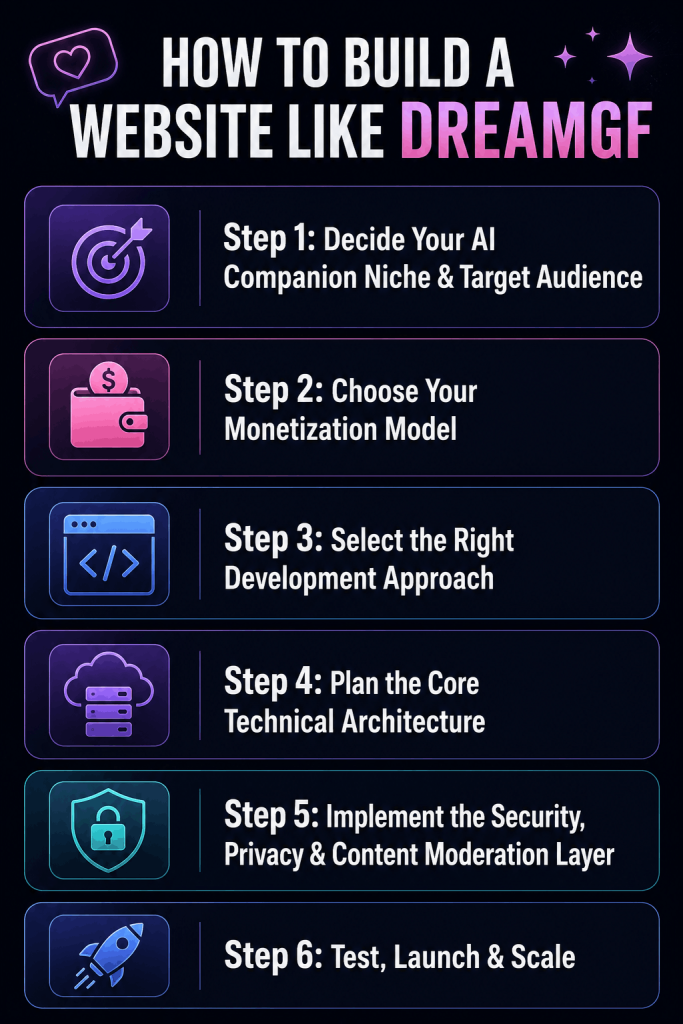
Step 1: Decide Your AI Companion Niche & Target Audience
The AI companion market is highly competitive, so narrowing down to a specific niche helps position your platform better. Building a DreamGF-like website is about creating an AI girlfriend platform, specifically in the NSFW niche.
Instead of blindly copying all the platform features of DreamGF and launching a similar companion, explore specialized niches and roleplay scenarios.
A few popular niches for DreamGF clone include:
- Romantic AI companion
- Anime & Manga Characters
- Gaming Companions
- Cosplay & Fictional Characters
- Fantasy Roleplay Scenarios
Research your target audience and build detailed personas with profile, feature preferences and usage patterns. This refines your companion features, marketing strategies and pricing model better.
Step 2: Choose Your Monetization Model
The biggest mistake founders make is to consider the monetization model as an afterthought. Despite a solid niche idea and platform scope, a robust monetization model is what defines the profitability aspect.
Here’s a comprehensive breakdown of the revenue model:
- Subscription: A recurring monetization model that generates consistent revenue from monthly and annual subscriptions. While the basic tier offers limited conversations, tiered plans unlock premium features, token upsells and multimodal interactions.
- Credits or Pay-Per-Use: Most AI companions use a hybrid revenue model, combining subscription and credit-based systems. While the subscription covers unlimited messages, fixed monthly tokens, faster responses, charge for premium interactions. This includes AI image generation, extensive character library, voice interactions and exclusive roleplay scenarios typically provided through credit or token system.
- In App Purchases: This includes virtual gifts and add-ons such as boosts or special avatars for level or relationship progression.
- Affiliate Partnerships: Promote niche-related products or services and earn commissions or revenue-share. Similarly, advertise dating apps or other tools within your website and earn additional revenue.
Step 3: Select the Right Development Approach
You have two options for building your AI companion clone: building from scratch or white-label companion clone solutions.
Custom Development (Building From Scratch)
Custom development offers you total control over the design and development process. But imagine building the entire AI companion infrastructure from scratch. There’s much that needs to be done: choosing the right AI models, model training, setting guardrails and integrating the complete architecture together.
This makes the development process complex, unless you have prior experience or a strong development team that takes ownership of the companion development process. Besides, building and scaling a custom-built model is an exponential cost, factoring in the long development cycles and high risk of launching a new AI companion.
White-Label Companion Clone Solutions
Pre-built companion solutions are practical alternatives to the traditional custom building approach. You choose the niche, monetization model and necessary customizations, and the provider tailors the white-label solution to fit your business needs. You get a performance-ready, secure and scalable companion with complete source code ownership.
Best of all, you can launch your DreamGF-style companion within 1-2 weeks at a fraction of the original development cost. If you’re an entrepreneur looking to bring your idea to market faster, this approach is ideal, given its obvious speed advantage and proven model.
Step 4: Plan the Core Technical Architecture
A production-ready companion architecture typically includes a modular, layered architecture.
A high-level DreamGF companion architecture consists of the following components:
-
AI Orchestration Layer
Acts as a middleware between the user and AI models. It manages context, routes requests to the right AI model, and combines outputs to generate a tailored response.
-
Character Engine
It decides your AI model’s personality, values, and conversation tone. The character engine generates real-time conversations by keeping track of emotional state and conversation history, and generates personalised AI responses.
-
Personalization and Memory Layer
This layer allows users to retain user context by recalling user preferences, personal details, and interaction history. Personalization helps to maintain continuity and develop deep, consistent and context-aware relationships.
-
Multimodal Processing Pipeline
This ensures realistic, feature-rich user interactions beyond text chat. The AI model can process and generate multiple types of data, including text inputs, voice messages, images and even animated avatars.
-
Payment Gateway
The secure payment gateway layer handles subscription plans, in-app purchases, premium upsells, credits/ tokens, refunds and transaction security. While Stripe and PayPal are ideal for SFW companions, choose high-risk payment processors like Segpay, CCBill and Epoch for NSFW companions. Look for providers with reasonable card processing rates for adult AI content, recurring subscription billing, chargeback handling, and strict compliance features.
-
Analytics Engine
This layer tracks user engagement, retention, revenue and conversions through custom dashboards or reporting tools. It also offers valuable insights into conversation quality, feature usage and subscription metrics.
All these layers operate synchronously to share contextual state across sessions and to generate natural, emotionally aware responses.
Step 5: Implement the Security, Privacy & Content Moderation Layer
While AI companions offer emotional companionship, they love to feed on your personal data. 80% of companion apps use data to track users. This could be either device-based tracking or sharing information with external websites like data brokers.
Users often disclose sensitive information, personal details and personal preferences, the way they converse with human companions. Instead of churning profits from loneliness, adopt a security-first design for long-term business sustainability.
A Multi-Layered Approach for Security, Privacy and Compliance
-
Age Verification & Compliance Check
Implement strict age filters and verification checks, allowing only users over 18 years of age to access the platform. In most AI companion platforms, the NSFW content is often gated behind age verification, protecting minors from explicit content.
-
Data & Media Encryption
Most companions don’t use end-to-end encryption, so sensitive information is potentially exposed through data leaks. Use TLS and HTTPS to encrypt messages when transmitted from device to server. For data at rest, implement AES-256 or equivalent encryption standards to protect data hosted on servers from potential breaches or attacks.
-
AI Guardrails and Data Minimization
Implement appropriate emotional and behavioural safeguards to prevent exploitation of user vulnerabilities. Establish fair, transparent data policies to gather only essential details that are absolutely necessary.
-
Content Moderation
Monitor AI model for offensive language, toxic behaviour or abusive patterns. This ensures the companion generates ethical responses within the defined personas.
-
Regulatory Adherence
AI companions must comply with standard legal and regulatory standards. EU’s AI Act lays a strong foundation for establishing secure, reliable and trustworthy chatbots. It introduces transparent obligations to inform users that they are interacting with an AI system or that the content is AI-generated. GDPR compliance involves secure handling of personal data, including explicit consent for data processing.
Step 6: Test, Launch & Scale
Now, you have built your companion clone. You have built the features, integrated the AI models, and streamlined the deep functional workflows. AI model testing often involves a multi-layered testing approach.
AI response evaluation is one of the significant parts of AI companion testing. This involves evaluating the response latency, conversational memory and emotional intelligence.
Safety and boundary checks include automatically flagging harmful behavior, crisis response, or exploitative uses. Lastly, test your companion clone for personality drift and monitor changes in tone and emotional alignment over extended conversations.
Before deployment, train the AI models on your niche data and connect it with essential third-party tools.
Scaling Strategies for AI Companion:
- Implement long-term context and expand memory
- Tiered AI model rerouting requests for faster response retrieval
- Multimodal experiences, such as voice, video and avatar beyond text chats
- Deeper AI analytics and feedback loops
- Scale revenue with freemium upsells, B2B partnerships, and an advertising model
Tech Stack for DreamGF Clone Development
Building a robust, secure and powerful AI companion platform requires a modern technology stack that’s designed to fit your business goals and budget.
Frontend Technologies
The frontend technologies help to build fast, interactive and responsive UI that retains users longer. Next.js and React are popular technologies for fast page loads, server-side rendering, and smooth chat transitions.
For mobile frameworks, Flutter is a go-to-choice for cross development offering a single codebase that works across both iOS and Android platforms. Platform-specific languages like Swift (for iOS) and Kotlin (for Android) are ideal for platform-specific or native development.
Backend Technologies
The backend holds your companion platform’s business logic and core functionality. From real-time interactions to API logic and data storage, a powerful backend ensures your platform runs smoothly.
Node.js (Express.js), Python/Django are key backend technologies for building high-performing, scalable platforms. On companion platforms, users expect responses within 1-2 seconds, which directly impacts session engagement and user retention.
Database
Database & memory are critical for conversation history, user preferences, and maintaining context across conversations.
Redis handles the short-term memory, while MongoDB stores long-term memory, including user preferences and chat history. Together, they ensure the companion engages users with real-time conversations and maintains a coherent personality.
AI Models
DreamGF Clone workflows are powered by multiple AI systems working in tandem.
- Natural Language Processing
Helps companions to interpret and generate highly personalized, human-like conversation responses.
- Image & Video Generation Module
Navigates seamlessly from static text prompts to dynamic visual conversations such as photos and videos. Stable Diffusion, Flux, and ImageGen for high-quality image generation models.
- Voice AI
The voice messaging feature helps the AI clone to reply in pre-generated, natural voices instead of mechanical ones. ElevenLabs and Whisper AI are prominent tools for AI voice interaction.
- AI Features
Tracks user behavior to recommend profiles and engaging personalized experiences.
Cloud Hosting & Dev Ops
For SFW companions, mainstream cloud providers such as AWS, Google Cloud and Microsoft Azure offer reliable, scalable infrastructure for companion deployment.
However, many hosting providers restrict adult content. Typically, VPS hosting is preferred more than shared hosting for greater flexibility, high performance and unrestricted content policies. It also offers root-level access, scalability, and an isolated virtual environment for seamless business growth.
Popular adult hosting services include Hostinger, DreamHost, Liquid Web, and Kamatera.
Security & User Authentication
OAuth and JWT enable secure user authentication flows and access delegation. Cloudflare provides fast delivery, DDoS protection and caching, significantly reducing load times.
What is the Development Cost to Build a Website Like DreamGF?
The cost to build a DreamGF-style website is $25,000 to $150,000, depending on whether you are building a basic companion or a full-featured solution. The actual cost depends on your LLM models, customization level and infrastructure complexity.
Typically, a white-label AI companion is a smart, cost-effective alternative, cutting down the timeline to 1-2 weeks from 12 months, with a proven business model already in place.
Cost Breakdown Based on Development Strategy
| Development Approach | Estimated Cost | Timeline |
| Custom-Build Companions | $25,000 – $150,000+ | 4-12 months |
| White-Label DreamGF Clone Solution by Fanso.io | Starting at $2,500 for MVP platform | 1-2 weeks |
AI Companion Platform Cost Breakdown based on Complexity
| Platform Complexity | Features | Estimated Cost |
| Basic Companion Platform (MVP) | Simple chat UI, pre-defined personas, memory module, payment flows, and admin panel | $25,000 – $50,000 |
| Medium-Level Complexity | Character customization, roleplay scenarios, long-term memory, image-generation, voice messaging and analytics | $50,000 – $70,000 |
| Advanced Companions/ Production-Grade Solutions | Video generation, relationship progression, multi-lingual support,advanced memory, content moderation flows, and deep analytics | $70,000 – $150,000+ |
Factors Affecting DreamGF Clone Development:
- Infrastructure Complexity & Scalability
- UI/UX Design
- AI Models & Memory Integrations
- Multimodal Capabilities
- Development Approach (Custom Build vs White-Label Clone Scripts)
- Developer Fees & Team Location
- Security & Compliance Features
Final Thoughts
The virtual companionship market is a competitive landscape with big players like Candy AI and Janitor AI. However, the popular AI companions also have existing platform gaps, including generic personalities, poor relationship progression, or limited context across sessions. If you’re building a DreamGF alternative, you scale on these gaps, launch viable alternatives and establish a profitable business.
At Fanso, we help you build the full development stack for AI companion clones and launch a scalable architecture that most businesses take 12-18 months to build. Thus, you get the foundational framework, built-in monetization ready, so you can focus on the acquisition and scaling strategies. Take the next step, connect with our team to build and launch your companion faster at scale!
FAQs for How to Build a Website Like DreamGF.ai
1. How long does it take to create a website like DreamGF.ai?
Developing a basic AI companion through custom development takes 4 to 6 months. Advanced features like deep character customizations, multimodal interactions, long-term memory and image and video generation extend the timeline to around 8 to 12 months. White-label AI companion clones help to skip the groundwork, reducing launch time to 1-2 weeks.
2. What is the cost to build a website like DreamGF.ai website?
The realistic development cost for building a DreamGF-style companion is around $25,000 to $150,000+, depending on feature complexity, LLM choice, multimodal interactions and custom integrations.
3. Which AI models are recommended to integrate into the AI companion platform?
Here are the recommended AI & NLP models for AI companion clone development:
- Open-source models like Mistral, Llama
- Voice models like ElevenLabs and Whisper AI
- Image Generators like Stable Diffusion, Dall-E, Midjourney
4. Can you use white-label solutions to build a full-fledged companion website like DreamGF.ai ?
Yes, white-label companions offer pre-built solutions with subscription flows, built-in monetization, real-time interactions, and character customization to launch a full-fledged AI companion.
5. How to differentiate my AI companion platform from competitors?
Focus on character customization, long-term memory, multimodal experiences, and security-centric architecture to build a competitive virtual companion.