TL;DR
- The cost of a creator marketplace website depends on scope, design complexity, customizations and development approach.
- Cost range based on development approach:
- Custom-built scripts: $50,000 to $150,000+
- Ready-made creator marketplace solutions: $700 to $1500 (MVP development)
- Hidden development expenses include server and hosting, integrations, post-launch support, and marketing spend.
- Launch an MVP, use open source frameworks, choose scalable solutions and optimize media storage costs to reduce long-term costs.
- Entrepreneurs and startups can use an all-in-one creator marketplace software provider like Fanso.io to launch and scale their platform while staying within the budget.
While building a creator marketplace is an exciting journey, estimating the development cost is one of the most challenging parts. Besides, software requirements often shift throughout the development journey and are often influenced by stakeholders and user feedback. Given the many variables involved, providing a precise cost estimation for complex systems like the creator marketplaces is not straightforward.
In this detailed guide, we provide a structured approach for estimating the cost to build a creator marketplace website, helping you move from wild guesses to a more realistic financial projection.
Types of Creator Marketplace Websites
A creator marketplace is a digital platform that connects creators and influencers with their target audiences. It empowers creators to monetize from content offerings, digital products or sponsorships, and allows fans to access exclusive content.
Let’s look at the different types of creator marketplace websites:
| Marketplace Type | How Does It Work? | Example |
| Creator Subscription Marketplace | Fans can purchase subscriptions and access exclusive content | OnlyFans, Patreon, Cameo |
| Service Marketplace | Creators sell their professional services like writing, graphics video editing, consulting or coaching | Upwork, Fiverr |
| Course & Learning Marketplace | Educators and subject experts sell learning resources such as courses, live classes, workshops | Udemy, Skillshare |
| Digital Product Marketplace | Creators monetize by selling digital products such as courses, e-books, templates, etc. | Gumroad, Etsy |
| Community-Based Learning Communities | Built around a niche community where creators can sell video tutorials, courses, and coaching services. | Fitness and gaming creator communities |
In this blog, we are especially focusing on the development cost for building creator subscription marketplaces.
How Much Does it Cost to Build a Creator Marketplace Website?
The cost to build a creator marketplace is $50,000 to $150,000+, approximately, depending on the platform complexity and customization. While the actual cost might vary, defining your platform scope, monetization model, and post-launch path provides the estimated development cost.
Now, let’s understand the development cost from different perspectives!
Cost Based on Platform Complexity
1. Basic MVP
- The core feature set includes user profiles, search & filtering, messaging and payment integration, reviews/ratings, and admin panel.
- Estimated Cost: $50,000 to $70,000
- Timeline: 4-6 months
2. Mid-Level Creator Marketplace
- Include features such as automated payouts, advanced analytics, push notifications and advanced search features for a slightly more complex creator marketplace.
- Estimated Cost: $70,000 to $80,000
- Timeline: 6-8 months
3. Advanced Platforms
- For an advanced creator marketplace, scale up with AI-powered flows, deep third-party integrations, and real-time analytics. Add these features once your MVP platform gains traction and attracts an initial set of platform users.
- Estimated Cost: $80,000 to $150,000+
- Timeline: 8-12 months
Development Approaches and Cost Comparison
Here’s the cost breakdown based on the build approach:
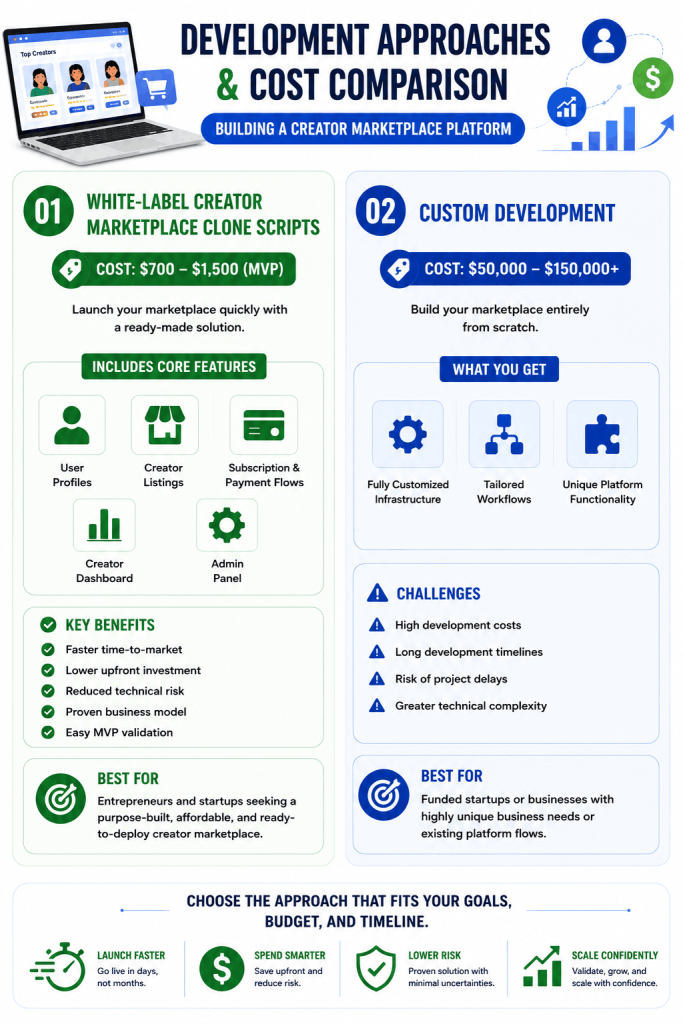
1. White-Label Creator Marketplace Clone Scripts – $700 to $1500 (For MVP)
Pre-built creator marketplace clone scripts help you launch faster at a minimal budget and validate your ideal early. The core features include user profiles, listings, subscription flows, payments, creator dashboard and admin panel. Entrepreneurs can reduce the risk of technical failures and skip reinventing the wheel with this proven model.
Best For: Entrepreneurs and startups who need a purpose-built, ready-to-deploy and affordable marketplace solution
2. Custom Development – $50,000 to $150,000+
This approach involves building the entire marketplace infrastructure from scratch, without any foundational framework. However, you’re not launching Amazon from day one; you’re putting forth a viable MVP with core features. The trade-offs: high development cost, extensive project timeline, unexpected project delays, and huge risk.
Best For: Funded startups or businesses with highly unique business needs or existing platform flows.
Custom-Built Platforms Vs. White-Label Clone Scripts
| Cost Category | Custom Development | White-Label Creator Marketplace Clone Scripts |
| Launch Time | 3-12 months | 5-6 days |
| Initial Build Cost | $50,000 – $150,000+ | $700 to $1500 (For MVP Platform) |
| Long term Control | High | High |
| Technical Skills | Highly specialized software engineering skills | Not Required |
| Hosting Cost | $42 – $150 per month | $42 – $150 per month |
| Total Cost of Ownership | High | Low |
Feature-by-Feature Cost Breakdown
Here’s an estimated cost of building the essential feature stack in a custom-built marketplace:
| Feature | Development Time (40 hours/ week) | Estimated Cost ($40 per week) |
| User & Profile Management | 4 weeks | $6,400 |
| Age Verification | 2 weeks | Based on platform and search volume |
| Subscription Management | 12 weeks | $6,400 – $19,200 |
| Community | 4 weeks | $6,400 |
| Creator Analytics | 4 weeks or more | Depends on complexity |
| Content Management | 4 weeks | $6,400 |
| Messaging | 8 weeks | $12,800 |
| Payment Workflows | 2 weeks | $3,200 |
| Creator Discovery | 4 weeks | $6,400 |
| Admin Panel & Analytics | 8 -12 weeks | $12,800 – $19,200 |
| Live Streaming | 4-6 weeks | $6,400 – $9,600 |
| Total Creator Marketplace App Cost | 4-12 months | $67, 200 – 96,000 |
The rough estimate for above mentioned features lands between $67,000 – $96,000, which aligns with the $50,000 to $150,000+ range, depending on the features you choose.
Hidden Creator Marketplace Website Development Costs (Often Overlooked by Businesses)
Most platform owners plan the development cost of the core infrastructure and underestimate the total cost of ownership. But the final cost often extends beyond development and involves post-launch and maintenance activities. So, plan at least 10% to 15% of your initial spending as post-launch costs to prevent budget overruns.
1. Server & Cloud Hosting
As your platform grows, server and cloud infrastructure costs increase to meet growing production needs. Performance optimization techniques such as auto-scaling, caching, database audits and CDN networks help to manage unexpected cost spikes.
Costs: $ 42 – $150 monthly
2. Third-Party Tools
Third-party API costs, such as payment gateways, video streaming, analytics and email marketing software, can scale up platform costs. Stripe Connect, Sendbird, Google Analytics, and Agora are the most popular integrations.
Costs: Varies depending on the number of third-party integrations
3. Maintenance and Support
Post-launch maintenance activities like bug fixes, troubleshooting, software upgrades and technical support incur a fixed cost annually. To ensure your marketplace is fully functional and performance optimized, plan $5,000 to $7,000 recurring costs monthly.
For pre-built creator marketplace clone scripts, the maintenance & support are included in the base plan for the first six months to one year.
Costs: $5,000 – $7,000 annually
4. Marketing and User Acquisition Costs
Acquiring creators and users is often one of the biggest cost drivers for a creator marketplace. From investing in paid ad campaigns to influencer collaborations and content marketing strategies, the marketing spend is often overlooked. Allocate a fixed budget for social media marketing, referrals, SEO optimization, etc.
Cost: $500 – $5000
Factors Determining the Cost of the Creator Marketplace Website
Unlike static websites, marketplaces are dynamic ecosystems, so costs vary significantly depending on several factors.
1. Marketplace Complexity
A simple product marketplace like Etsy is less complex than a subscription marketplace like Patreon or Cameo. These platforms need more dynamic features, such as live streaming, subscription flows, escrow and creator-matching systems. Thus, more logic goes into building and implementation.
2. UI/UX Design
Your marketplace’s UI/UX shapes the users’ journey and engagement. Investing an initial budget on UX is crucial and includes user research, prototyping, wireframing and testing to fit users’ needs and expectations. As user preferences evolve, ongoing interactions and feedback often add to the costs. That said, neglecting UX design can increase the overall costs in the long run.
3. Hourly Rates and Team Location
The developer rates are one of the biggest determining factors of project costs. And it varies significantly based on the developer’s or team’s location. Typically, offshore teams reduce the development costs as compared to US-based teams. Beyond the development value, evaluate the development team’s expertise and skills as well.
| Country/Region | Hourly Development Rate |
| North America | $65 – $100 |
| Latin America | $50 – $70 |
| Western Europe | $55 – $80 |
| Eastern Europe | $40 – $60 |
| South Asia | $20 – $50 |
4. Platform Choice
Planning for a web-based platform, an iOS and an Android app altogether? Launching on multiple platforms is more expensive than a single web-based launch. Native platforms are designed specifically for iOS or Android devices.
While choosing native development offers better performance, seamless UX, app stability, it increases the development costs. On the other hand, developing native and web-based platforms requires separate codebases, skillsets, and testing flows.
Cross-platform frameworks like Flutter and React Native are affordable development frameworks as compared to single codebases.
5. Security & Compliance
Extra layers of security, such as multi-factor authentication, DRM protection, AI-powered fraud detection, and automated content moderation, add an additional 20% to 50% costs to the budget.
6. Payment Processing Fees
Like any other business, marketplace that accepts credit cards and online payments charge a small transaction fee (typically 2% – 6% depending on the payment processor). The amount depends on the risk of transaction, card type and pricing model.
7. Post-Launch Maintenance and Scaling Costs
Ongoing maintenance and scaling costs compound quickly and drain your development costs. This involves fixing critical bugs, technical debt, and other preventive measures. Scaling costs involve horizontal, vertical costs, CDNs, and database scaling costs.
8. Third-Party Integrations
Even with the best platform features and customizations, your marketplace needs some third-party integrations. This typically includes Stripe or PayPal payment integrations, Google Analytics, livestreaming APIs, marketing software, to expand and scale your operations.
How to Reduce the Cost of Creating a Creator Marketplace?
The development cost of the creator marketplace doesn’t increase linearly. So, careful cost optimization alongside quality assurance is the key.
Here are some effective cost reduction strategies:
1. Build a Minimum Viable Product (MVP)
Prioritize building the core features first. Integrate the advanced features such as real-time analytics, AI recommendations and automated moderation flows later as you scale your platform. Launching with an MVP platform not only saves your initial build cost but also provides enough time to validate and iterate on user feedback.
2. Leverage Pre-Built & Scalable Development Approach
Building from scratch demands significant budget and development efforts. Choosing pre-built creator marketplace solutions offers a strong foundation to scale your platform and focus on user acquisition and marketing activities instead. This accelerates the development timeline and niche differentiation while offering a scalable infrastructure to build on.
3. Implement Open-Source Frameworks and Libraries
Open-source development cuts down on licensing costs, yet builds a solid foundational framework. React, Node.js, and Laravel are reliable technologies with a large development community. Leveraging such technologies helps you build long-term assets with better architecture and gain complete control over your codebase.
4. Optimize Media Storage Costs
Media storage and bandwidth are major cost drivers for creator marketplaces. These marketplaces often host large volumes of media files, content, and even livestreams, leading to image and video bloat. Instead of compressing media files, use adaptive streaming and CDN caching to optimize media storage costs.
Conclusion
While the actual cost of building a creator marketplace varies, considering the different development variables provides a more realistic estimate. Custom-built marketplaces offer tailored features, workflows and a high level of customization. However, longer timelines and massive budgets can weigh down on early market entry and business growth.
White-label creator marketplace clone scripts are a smart starting point. You get a launch-ready multi-creator platform available for $1,500 with prebuilt features to scale with confidence. Get in touch with our powerful squad to build secure, scalable and powerful creator marketplaces faster!
FAQ-Related to Cost to Build a Creator Marketplace Website
1. How much does it cost to create a creator marketplace website?
The cost to develop a creator marketplace website ranges from $50,000 to $150,000+ when built from scratch. Factors such as project complexity, tech stack, UI/UX design, and development approach. Using white-label creator marketplace clone scripts like Fanso cuts down the 80% of development cost.
2. How long does it take to launch a creator marketplace?
Building a creator marketplace from scratch takes 4 – 12 months, while white-label creator marketplace clone scripts speed up the launch to 5 – 6 days.
3. How to build a creator marketplace?
To build a creator marketplace, decide on your niche and the type of marketplace, choose your tech stack, identify the core features, onboard the right creators and finally launch and promote your website.
4. Can you build a creator marketplace without custom development?
Yes, white-label clone scripts offer a pre-built framework to launch a creator marketplace within 5 to 6 days without any coding expertise.