
Key Takeaways:
- FeetFinder is a fetish marketplace for buying, selling, and viewing foot content, including custom requests.
- It prioritizes privacy and security with age verification, PCI compliance, and blurred uploads.
- Creators on the platform can monetize through pay-per-content, premium subscriptions, tips, and custom content.
- Key Features: User profile & registration, content uploads, content discovery, private messaging, payments, creator payouts, ratings, and reviews.
- The development cost for an MVP FeetFinder app ranges from $25,000 to $50,000, depending on app complexity and other factors, but by using a clone script, you can create a web app at an affordable cost.
The adult industry is adapting faster from glossy magazines to personalized content marketplaces. Fetish platforms like FeetFinder are redefining the game with a user-friendly interface, innovative business model, and privacy-first policy.
This blog offers a practical guide on building FeetFinder-style apps, such as a business model, core features, key development steps, cost breakdown, competitive differentiators, and next steps.
Table of Contents
- 1 What is FeetFinder? Why is it Popular?
- 2 Understanding FeetFinder: Business Model & Monetization Strategy
- 3 How to Create an App Like FeetFinder: 7-Step Guide
- 4 Cost Breakdown & Timeline
- 5 How to Gain a Competitive Edge with your FeetFinder-style App?
- 6 Next Steps: Building an App like FeetFinder
- 7 FAQ-Related to How to Build an App Like FeetFinder
What is FeetFinder? Why is it Popular?
FeetFinder is an online marketplace for buying and selling foot content, including photos and videos, as well as custom requests. Sellers can create their profiles, upload content, and start earning. On the other hand, interested buyers purchase feet content for a price.
With millions of users, FeetFinder is an amazing platform for foot fetish lovers and accessible in countries like USA, UK, Canada, European Union (all countries except Turkey), Switzerland, Norway, Iceland, Mexico, Australia, New Zealand, South Africa, Argentina, and Jamaica.
Here’s why FeetFinder is thriving:
- Foot Fetish Focus: With a narrow focus on foot fetish content, FeetFinder attracts the right creators and audience, targets marketing channels, and builds authority.
- Safety, Security, and Privacy: The marketplace employs age-verification, PCI-compliant moderation, and protects user identity.
- Easy-to-Use & Beginner-Friendly: A simple user interface, a focused niche, and an easy dashboard offer a clutter-free experience for buyers and sellers.
- Flexible Monetization: Creators can monetize from pay-per-content, subscriptions, albums, tips, and custom requests.
- Anonymity: FeetFinder allows sellers to maintain anonymity by showing only usernames, no-face content, and built-in blurring for previews.
Understanding FeetFinder: Business Model & Monetization Strategy
FeetFinder is a two-sided content marketplace that connects buyers interested in foot content with sellers looking to monetize it. The platform acts as an intermediary, providing hosting, payments, verification, and moderation features.
Core Monetization Streams:
- Seller Subscriptions: FeetFinder earns from a seller subscription fee of $4.99 per month (basic) or $14.99 per year (premium) for using the platform services.
- Platform Commissions: Additionally, the platform charges sellers 10%–15% commission depending on the subscription plan, and creators keep the remaining earnings.
- Buyer Subscriptions: Buyers can unlock access to all of the seller’s content for a subscription fee decided by the seller.
- Tips: Buyers can send additional tips to sellers on profiles or messaging and help them earn alongside content sales.
Core Features for Building FeetFinder App
Here are the core features required to build a FeetFinder MVP:
- User Registration & Verification: Create unique registration flows for seller and buyer profiles. For example, sellers need to enter basic credentials, submit valid government ID proof, and get their profile verified. Buyers can simply enter their username, email, country, and link a card to get started.
- Content Upload & Management: Once a seller profile is created, sellers can upload pictures, videos, or create albums.
- Search & Content Discovery: Buyers can browse through seller profiles using keywords and filters, and follow or message their favorite sellers.
- Secure Messaging: Private chat between buyers and sellers keeps the conversations secure and confidential. Buyers can ask questions, make custom requests, and negotiate, while sellers can get to know preferences, send promotional offers, and monetize easily.
- Monetization Features: Recurring subscription plans, locked content, and tips help sellers earn money from multiple revenue streams.
- Payment Gateway & Payouts: Integrate PCI-compliant payment processors like Paxum and Segpay for creator payouts and platform transactions. Typically, Stripe and PayPal don’t support fetish content, so choose your payment partner accordingly.
- Reviews & Ratings: Allow buyers to leave reviews or ratings on seller profiles. This helps sellers to build credibility and attract new buyers.
How to Create an App Like FeetFinder: 7-Step Guide
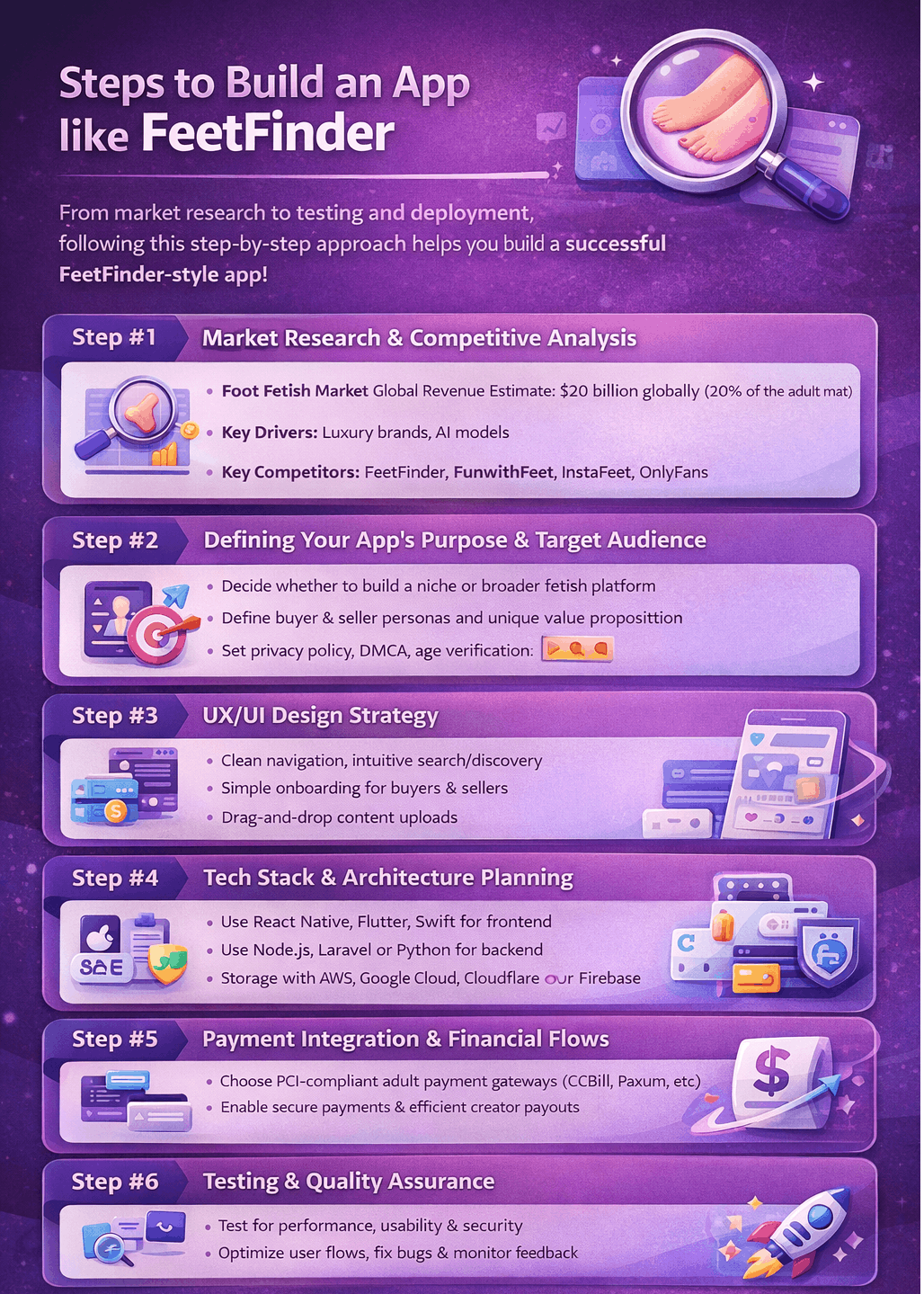
From market research to testing and deployment, following this step-by-step approach helps you build a successful FeetFinder-style app!
Step # 1: Market Research & Competitive Analysis
Most businesses miss the initial groundwork and simply mimic the FeetFinder model. So, first, let’s analyze the demand for foot fetish content, current market trends, and competitors.
- Foot Fetish Market Global Revenue Estimate: $20 billion globally (20% of the adult market)
- Key Drivers: Luxury brand and personalized experiences, AI-generated models
- Key Competitors: FeetFinder, FunwithFeet, InstaFeet, OnlyFans (broader adult content)
Identify the top 3-4 competitors and evaluate their core strengths and value gaps. Look at their features, pricing, community feedback on Reddit, and other marketing channels. Build on these gaps and gain a competitive edge over them.
Step # 2: Determine Your App’s Goal & Study Audience
Now, you have a clear idea of the big picture of the overall foot fetish market. Let’s move on to defining your app’s purpose and target audience.
First, decide whether you’re building a foot fetish app or a broader fetish platform. Second, craft a clear persona of your users (buyers and sellers) with their needs, expectations, and pain points.
Lastly, define your unique value proposition, something like “Trusted marketplace for fetish lovers and sellers.” Craft the privacy policy, refund terms, DMCA process, and age verification requirements in the initial stage.
Step # 3: UX/UI Design Strategy
Designing a simple, secure, and privacy-first platform requires planning.
Here are the key elements that make a powerful platform design:
- Clean navigation, intuitive search, and discovery pages
- Simple, quick, and separate onboarding flows for buyers and sellers.
- Drag-and-drop features and bulk upload for content upload
- Include a request form inside chat for a custom price and delivery time.
- Mobile responsive UX and optimized design
- Embed privacy-first controls such as pseudonyms, built-in blurring for uploads, etc.
Step # 4: Tech Stack & Architecture Planning
Recommended Tech Stack:
| Technology Aspect | Technology & Framework | How Does it Help? |
| Frontend | React Native, Flutter, Swift or Kotlin | Responsive design on Android/iOS and Swift and Kotlin for native development. |
| Backend | Node.js, Laravel, Python (Django) | Enables backend server logic and API integration |
| Database | PostgreSQL, MongoDB, Redis | Storing user data, platform content and transactions |
| Cloud Storage | AWS S3, Google Cloud CloudFlare, and Firebase Storage | Reliable storage and content delivery of images and videos |
| Payment Gateway | Paxum or Segpay | Secure payments, recurring billing support and one-time payments. |
| Security | SSL wildcard, JWT auth | End-to-end data encryption and secure user sessions. |
| Real-time Messaging | Socket.io and network protocols | Enables private chats between buyers and sellers. |
Step #5: Payment Integration & Financial Flows
Choose a PCI-compliant payment processor to handle platform transactions and set creator payouts. The payment provider you opt for needs to support international payments and fetish/adult content. Stripe and PayPal restrict adult content, and there’s a risk of potential account shutdown.
Popular Adult Payment Gateways:
- CCBill
- Paxum
- SegPay
- Verotel
- Epoch
- Crypto gateways (Optional)
Additionally, look for features such as subscription billing, autorenewals, and chargeback handling. Consider regional payment gateways for flexibility and to minimize waiting periods.
Prioritize setting up a secure, quick, and efficient creators’ payouts to avoid disputes and reduce churn. You can choose a weekly, bi-weekly, or monthly payout, with a minimum withdrawal threshold.
Step # 6: Testing, Iterate & Optimize UX
Conduct extensive testing across the complete feature set, including performance, security, and usability. Ensure the app is accessible across different OS and devices, and under different network conditions. Identify bugs, fix issues, and vulnerabilities based on early user feedback. Iterate and optimize UX and platform flows, so the app is up and running for the users.
Step # 7: Launch & Marketing Strategy
Traditional marketing doesn’t work for adult and fetish platforms. Hence, you need a smarter approach. With most mainstream advertising channels restricting these platforms, visibility is a stumbling block.
Here are the top marketing channels you can target for your FeetFinder app:
- Build a community on Discord, relevant subreddits, X, and join discussions.
- Partner with niche influencers and incentivize with a flat fee
- Promote strategically on X with memes, gifs, and trendy posts.
- Run affiliate programs where promoters earn commission for every referral.
Cost Breakdown & Timeline
The cost to develop an app like FeetFinder is approximately $25,000 to $50,000 (MVP), depending on the feature set and integrations.
| App Complexity | Cost Estimate | Development Timeline |
| Basic App (User profiles, content upload, payment integration, messaging) | $25,000-$50,000 | 3-4 months |
| Medium Complexity (Automated verification, blurring technology, multi-language support) | $50,000-$100,000+ | 5-7 months |
| Advanced App (AI integration, advanced moderation controls) | $120,000-$250,000+ | 9-12 months |
The development cost is variable and influenced by several factors from conception to deployment.
Factors Influencing Development Costs:
- Feature Complexity
- Tech Stacks
- Location
- Design & UX/UI
- Third-Party Integrations
Other Ongoing Costs:
- Hosting & storage – $42-$150 /month
- App store fees – Both Google and Apple take a fixed commission from the app store sales. Apple charges a standard 30% commission, while Google takes a tiered commission between 15%-30% depending on app type and revenue.
- Maintenance & support costs (10-20% of total cost) – Involves server maintenance, bug fixes, software upgrades, support, and compliance costs.
How to Gain a Competitive Edge with your FeetFinder-style App?
Inspired by the FeetFinder model, many businesses are exploring the foot fetish landscape. That’s why competitive differentiation is crucial. But how to stand out in the industry?
Win over your competitors by focusing on these areas:
- AI Integration: AI custom recommendations, AI message generators, smart pricing, and optimization are different ways to position yourself as an AI-powered marketplace.
- Better Security & Privacy Controls: Whether it’s enhanced content protection, watermarking, or automated ID verification, these features build users’ trust and brand reputation.
- Advanced Analytics: Creators get valuable insights from analytics on what’s performing, engagement, revenue trends and subscriber growth.
- Smart Content Discovery: Trending sections, recommendations based on purchase history, and advanced filters improve search experience.
Next Steps: Building an App like FeetFinder
The demand for fetish platforms is growing, and digital platforms, social media and technology advancements are fueling the growth further. Building an app like FeetFinder is a golden opportunity to explore the market potential and establish your own community.
The winning formula is: Identify an underserved niche, determine the right monetization streams, add security and moderation layers, and bet on the strategic marketing channels.
Focus on building a creator-friendly platform with advanced tools, high remuneration, and built-in promotional tools. Launching a FeetFinder-like app is a strong business move, only if your foundation is solid and powerful. We at Fanso provide a custom-built FeetFinder app, moving your idea into reality in the next 30 days, with security and scalability at the core.
Get a free consultation and a complete project roadmap from Fanso, the trusted platform builder by hundreds of businesses across the globe, to build a successful fetish marketplace in 2026.
💡Related Articles:
FAQ-Related to How to Build an App Like FeetFinder
1. What is FeetFinder?
FeetFinder is a popular foot fetish marketplace connecting interested buyers and sellers looking to monetize from foot photos, videos, and custom content.
2. How much does it cost to build an app like FeetFinder?
The cost to develop an app like FeetFinder typically ranges from $25,000 to $50,000+ with custom development, depending on the app’s complexity. Using a Fanso clone script, you can build a similar platform for $699–$1,499.
3. What are the benefits of building a FeetFinder App?
Tapping into the growing market demand, diverse revenue streams, brand authority, and proven business model are key benefits of building the FeetFinder app.
4. How long does it take to build a platform like FeetFinder?
Custom development takes around 3-12 months to build all the core features and functionalities from scratch.
5. What are the core features for a FeetFinder-like App?
Creator profile & verification, content management, search & discovery, payment integration, monetization features, privacy controls, messaging, ratings, and reviews are key platform features.
6. How is FeetFinder different from OnlyFans?
FeetFinder focuses on foot fetish content and is a trusted marketplace for buyers and sellers. OnlyFans is a broader creator monetization platform for adult creators, fitness trainers, fetish content sellers, and gamers. Look at our detailed FeetFinder vs. OnlyFans comparison guide.
7. What is the tech stack to build a FeetFinder app?
Use React Native or Flutter for the front-end, Node.js or Python (Django) for the back-end. PostgreSQL or Redis are recommended for databases, and AWS S3 and Google Cloud for secure storage and content delivery.