
TL;DR
- A Candy AI clone requires cloud hosting, application servers, AI integrations, databases, storage, real-time communication, CDN, security, and scalable resources.
- AI services can cost around $1,000-$5,000+/month, while cloud hosting may range from $50-$500+/month, depending on traffic and resource requirements.
- Total operating costs can reach $2,000-$10,000+ per month, depending on user activity, AI usage, media generation, storage, security, and other infrastructure needs.
- A clone script offers a pre-built infrastructure foundation for faster deployment, while custom development provides greater control over infrastructure architecture, AI integrations, and scalability.
- Fanso provides a ready-made Candy AI clone script that can help businesses launch faster and reduce the effort and initial investment required to build the platform from scratch.
Building a Candy AI clone requires more than integrating AI features and creating an engaging user interface. The platform also needs a reliable infrastructure setup to handle AI interactions, user data, generated media, and increasing user activity. A well-planned infrastructure ensures that these components work together smoothly while maintaining platform performance and reliability.
The infrastructure requirements can vary depending on the platform’s features, expected user traffic, AI capabilities, and development approach. Businesses may need cloud hosting, AI services, databases, storage, real-time communication, security systems, and scalable resources to support the platform as it grows.
In this guide, we’ll explore the key infrastructure requirements for a Candy AI clone, the factors that influence infrastructure costs, and the infrastructure differences between using a clone script and developing a custom platform.
What Infrastructure Does a Candy AI Clone Need?
The infrastructure requirements of a Candy AI clone depend on its features, expected traffic, and AI capabilities. The platform needs interconnected components to support AI conversations, personalized experiences, media generation, and user accounts.
The core infrastructure typically includes application servers, AI services, databases, and cloud storage for handling user data and generated content. These components are part of the broader Candy AI clone tech stack, while real-time communication, CDN support, and security systems help ensure smooth performance and reliability.
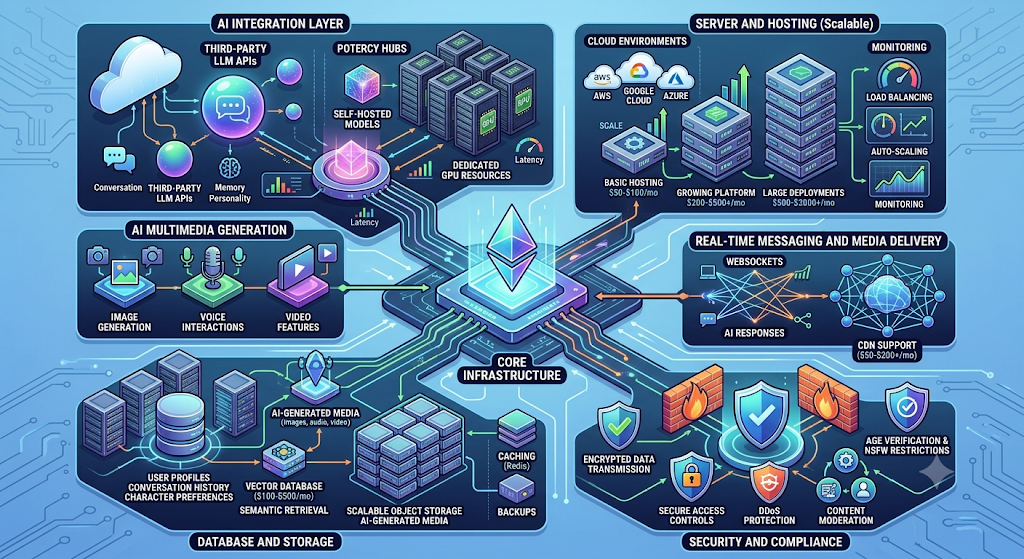
The setup can also differ based on the development approach. A clone script usually comes with a pre-built architecture, while a custom build provides more flexibility in designing the system.
Understanding these components early helps businesses plan a scalable infrastructure and estimate the costs involved before launch.
Server and Hosting Requirements
The server and hosting infrastructure form the foundation of a Candy AI clone, handling user requests, AI interactions, account data, and platform traffic. Since AI companion platforms can experience fluctuating workloads, the infrastructure should be flexible enough to allocate resources based on demand.
For an MVP, businesses can start with basic cloud hosting at around $50-$100 per month. As traffic and user activity increase, hosting costs may reach $200-$500+ per month, depending on additional servers, load balancing, backups, monitoring, and scaling requirements. Larger deployments with more demanding workloads can cost $500-$2,000+ per month.
Cloud providers such as AWS, Google Cloud, or Azure provide the flexibility needed to manage fluctuating workloads, while load balancing, auto-scaling, and CDNs can help maintain performance as traffic increases.
Platforms with AI image generation, voice interactions, or video features may require additional computing resources, depending on whether these workloads are processed through third-party APIs or hosted directly.
The right hosting setup ultimately depends on factors such as expected user volume, AI inference requirements, media consumption, storage needs, and long-term scalability plans.
AI Integration Requirements
AI integration is the core infrastructure layer of a Candy AI clone, supporting conversational AI, character personalities, personalized interactions, and AI-generated content. Businesses can connect third-party large language models (LLMs) through APIs or use self-hosted models, depending on their requirements for customization, performance, and data control.
Third-party AI APIs can simplify deployment because businesses do not need to manage AI models or GPU infrastructure directly. A Candy AI clone can use LLMs to power AI chat and conversational interactions, while AI voice services can support voice-based conversations and responses.
These services typically follow usage-based pricing, with LLM costs based on the number of input and output tokens processed. The overall expense depends on the AI model selected, token consumption, conversation volume, and user activity, which can increase as the platform grows.
Additional AI capabilities, such as image generation and content moderation, may require separate AI services and processing resources. These services can consume more computing resources than text-based interactions and may further increase the platform’s operational requirements.
Businesses opting for self-hosted AI models can gain greater control but require dedicated GPU resources and ongoing maintenance. Depending on the model and workload, GPU infrastructure can cost around $500-$5,000+ per month, adding significantly to the platform’s operating expenses.
As the platform scales, monitoring token consumption, API usage, response latency, model performance, and overall AI workloads is essential for maintaining a consistent user experience and managing infrastructure expenses.
Database and Storage Requirements
A Candy AI clone needs a reliable database and storage system to manage user profiles, account details, conversation history, character preferences, and other platform data. The database should support quick data retrieval while maintaining consistency as the platform grows.
For an MVP or smaller platform, database services may start at around $50-$300+ per month, depending on storage capacity, performance requirements, and the cloud provider. Platforms with persistent AI memory may also use vector databases to store embeddings and support semantic retrieval. Mid-scale vector database services can cost around $100-$500 per month, depending on usage.
AI-generated media such as images, audio files, and videos should be stored separately using scalable object storage solutions. Keeping media assets outside the primary database improves performance and simplifies storage management as media libraries grow.
Caching systems such as Redis can cost an additional $30-$150 per month while helping reduce database load and improve response times. Backup and disaster recovery solutions may also contribute to the overall storage costs.
The actual database and storage costs depend on the amount of user data, conversation history, AI memory, media generated by the platform, and data retention policies.
Real-Time Messaging and Media Delivery
Real-time communication is essential for a Candy AI clone because users expect AI responses, voice interactions, and media to be delivered with minimal delay. The infrastructure should support multiple conversations simultaneously while maintaining responsive interactions.
Technologies such as WebSockets can enable continuous communication between users and the platform. A Content Delivery Network (CDN) can also help deliver AI-generated images, audio, and videos faster by serving content from locations closer to users.
CDN costs may start around $50-$200+ per month, depending on bandwidth consumption and the amount of media delivered. Voice and video services may also involve usage-based charges.
As user activity grows, implementing caching mechanisms, scalable media storage, and optimized content delivery strategies can help reduce server load and maintain a responsive user experience. The overall infrastructure requirements will depend on media generation volume, bandwidth usage, and the frequency of user interactions.
Security and Compliance Requirements
A Candy AI clone may handle sensitive information, including user account details, private conversations, payment-related data, and AI-generated media. As a result, security should be incorporated at every layer of the infrastructure to protect user data and maintain platform reliability.
For platforms offering adult or NSFW features, additional considerations may include age verification, content moderation, access restrictions, and data-handling requirements.
Security infrastructure may also include SSL/TLS certificates to encrypt data transmitted between users and the platform, including Wildcard SSL certificates for securing multiple subdomains.
The exact security and compliance requirements depend on the platform’s target markets, user volume, and the type of data collected. Building security into the infrastructure from the beginning can help protect user data, reduce operational risks, and create a stronger foundation for future growth.
Scalability Considerations for a Candy AI Clone
As a Candy AI clone grows, its infrastructure must handle increasing numbers of users, simultaneous conversations, AI requests, and media generation without affecting performance.
A well-designed architecture enables businesses to scale individual components of the platform, such as servers, databases, AI services, and storage, without rebuilding the entire application.
Auto-scaling and load balancing can help distribute traffic across multiple servers during periods of high activity. Caching can reduce repeated database requests, while background processing can handle resource-intensive tasks such as image and video generation without slowing down the main application.
AI usage also needs to be considered when planning scalability. As more users interact with the platform, API requests and media generation can increase infrastructure and AI costs. Monitoring usage, setting rate limits, and tracking resource consumption can help maintain performance and control operating expenses.
The best approach is to start with infrastructure that matches the current workload and scale individual components as usage increases. This avoids unnecessary infrastructure spending while keeping the platform prepared for future growth.
Candy AI Clone Script vs. Custom Development: Infrastructure Differences
When comparing a Candy AI clone script with custom development, the infrastructure setup can differ based on the level of flexibility and customization required. A clone script typically comes with a pre-built architecture and core integrations, allowing businesses to launch with an existing infrastructure foundation and scale resources as user activity increases.
Custom development provides greater control over the infrastructure architecture. Businesses can select and configure cloud services, databases, AI models, storage systems, security layers, and scaling solutions based on their specific platform requirements. This approach also allows infrastructure components to be designed around unique AI capabilities and complex workloads.
As the platform grows, both approaches may require infrastructure scaling to handle increased user activity, AI requests, media generation, and data storage. However, a custom-built platform offers more flexibility to modify and optimize individual infrastructure components as requirements evolve.
A clone script is generally suitable for businesses that want a pre-built infrastructure foundation with simpler customization requirements. Custom development, on the other hand, is better suited for platforms that require greater control over infrastructure architecture, unique AI integrations, and advanced scalability.
How Much Does It Cost to Run a Candy AI Clone?
The ongoing cost of running a Candy AI clone depends on user activity, AI model usage, media generation, hosting, storage, security, and maintenance. Unlike the cost of creating a website like Candy AI, these are recurring expenses that can increase as the platform grows.
The following table provides an estimated cost breakdown of the major services and infrastructure involved:
Note: All listed services follow a monthly billing cycle, except for domain registration and Wildcard SSL certificates, which are generally charged annually.
| Cost Component | Estimated Cost |
| Domain | $10-$50 |
| Cloud Hosting | $50-$500+ |
| Application Servers | $50-$2,000+ |
| AI APIs | $1,000-$5,000+ |
| Database and Storage | $50-$500+ |
| CDN | $50-$200+ |
| Redis / Caching | $30-$150 |
| Wildcard SSL Certificate | $50-$500+ |
| Age Verification | $100-$1,000+ |
| Content Moderation | $100-$500+ |
| Monitoring and Security | $50-$500+ |
| Backup and Disaster Recovery | $20-$200+ |
AI services are often one of the largest variable expenses, particularly for platforms that support image, voice, and video generation. The overall cost can also increase with higher user activity, media consumption, and data storage requirements.
Businesses can manage operating expenses by using usage-based pricing, token systems, rate limits, caching, and cost-effective AI models for less demanding tasks. Regularly monitoring infrastructure use and AI spending can also help identify opportunities for cost optimization.
The actual operating cost will depend on the platform’s user base, feature set, AI model usage, and infrastructure architecture. Starting with essential resources and scaling them based on real usage can help businesses manage expenses as the platform grows.
Conclusion
Running a Candy AI clone requires reliable infrastructure for AI processing, data storage, media delivery, security, and scalability. While costs can increase with user activity and AI usage, starting with essential resources and scaling them as demand grows can help businesses manage operating expenses effectively.
The right infrastructure approach ultimately depends on your budget, feature requirements, expected user base, and long-term growth plans. Businesses can choose between a ready-made solution for faster deployment or custom development for greater control over the platform’s architecture and functionality.
For businesses looking for a ready-made Candy AI clone script, Fanso provides a customizable foundation for launching an AI companion platform based on specific business requirements.
FAQ Related to Infrastructure Requirements for a Candy AI Clone
1. What server infrastructure is required for a Candy AI clone?
A Candy AI clone typically requires cloud hosting, application servers, databases, scalable storage, AI integrations, and security services. The exact infrastructure depends on user traffic, AI workloads, media generation, and platform features.
2. How much does it cost to host a Candy AI clone?
Hosting costs vary based on traffic and resource usage. An MVP may start at around $50-$100 per month, while a growing platform may require $200-$500+ per month. Hosting is only one part of the total operating cost, which can reach $2,000-$10,000+ per month when AI services, storage, security, maintenance, and other expenses are included.
3. Does NSFW AI require different infrastructure?
NSFW AI does not necessarily require completely different infrastructure, but it may require additional systems for age verification, content moderation, access controls, and compliance. The specific requirements depend on the platform’s features and the regions it serves.
4. What is the biggest operating cost of a Candy AI clone?
AI usage is often one of the largest variable expenses, particularly when the platform supports high-volume conversations, image generation, voice interactions, or video. Depending on user activity and feature usage, AI-related costs can reach $1,000-$5,000+ per month for a growing platform.