
Content is the currency that drives subscription platforms in the fierce creator economy. But, how safe is a creator’s content on the dark web?
Be it a livestream, pre-recorded video, or a quick digital download, a cybersecurity attack is a prominent threat. Cybersecurity threats are predicted to cost $15.63 trillion by 2029.
So, what are the security measures subscription platforms must adopt? In this blog, we discuss the top anti-piracy features for creator subscription platforms and how Fanso helps with this.
Table of Contents
- 1 TL;DR
- 2 Why Creator Platforms Need Anti-Piracy Features?
- 3 What are the Consequences of Content Leaks on Creator Subscription Platforms?
- 4 Core Anti-Piracy Features for Creator Subscription Platforms Should Implement
- 5 Fanso.io’s Anti-Piracy Features Built for Creator Protection
- 6 Conclusion
- 7 FAQ-Related to Anti-Piracy Features for Creator Subscription Platform
TL;DR
- Content piracy poses a great threat to creators’ innovation and financial freedom. Safeguarding content protects creative expression, brand reputation and boosts revenue.
- Paid subscribers using the creator’s content, screen recording, AI repurposing, and account impersonation are different forms of content piracy.
- Revenue loss, reputational damage, emotional distress and legal problems are the consequences of content piracy.
- DRM, digital watermarking, user authentication, screen capture protection, multi-CDN security, and secure APIs are key anti-piracy features for creator subscription platforms.
- Digital Rights Management (DRM) involves a set of technologies and policies for encrypting and authorizing content access.
- Implement a DMCA process and include it in your terms and service policy to protect your platform content.
Why Creator Platforms Need Anti-Piracy Features?
Content piracy is a key concern for creator subscription platforms. It poses a great threat to the creator’s innovation and financial freedom. Hence, protecting your valuable content ensures the creator receives the credit they deserve for their efforts. Moreover, it also protects your creative expression, brand reputation, and revenue.
Here are the different forms of content piracy on subscription platforms:
- Paid subscribers using the creator’s content
- Screen recording during livestreaming
- Content scraping & bulk download
- AI repurposing/ deep fakes
- Account impersonations
If subscription platforms want to empower its creators, adopting appropriate security strategies is crucial. This helps platforms to safeguard content and prevent unauthorized access and theft.
What are the Consequences of Content Leaks on Creator Subscription Platforms?
Content creators in the gig economy are at increased risk of security breaches given their public visibility. In a survey by Piracy International, 4 out of 5 creators agreed on a growing risk of piracy threat, and more than 3 out of 4 agreed on a potential digital security threat.
When a creator’s content gets leaked, the following are the consequences:
- Revenue loss from subscriptions and one-time sales
- Reputational damage causing loss of trust
- Emotion & psychological distress
- Extensive legal consideration & fees
Further, it affects the trust and credibility of the platform as a whole. Thus, new creators think twice before joining the platform and investors would be hesitant to raise funds due to risk of long-term revenue losses.
Core Anti-Piracy Features for Creator Subscription Platforms Should Implement
So, what can subscription platforms do to avoid such security threats? “Prevention is better than cure.” Implementing strong authentication, access controls, and robust privacy policies helps significantly thwart such attacks.
Here are the key anti-piracy features for creator subscription platforms:
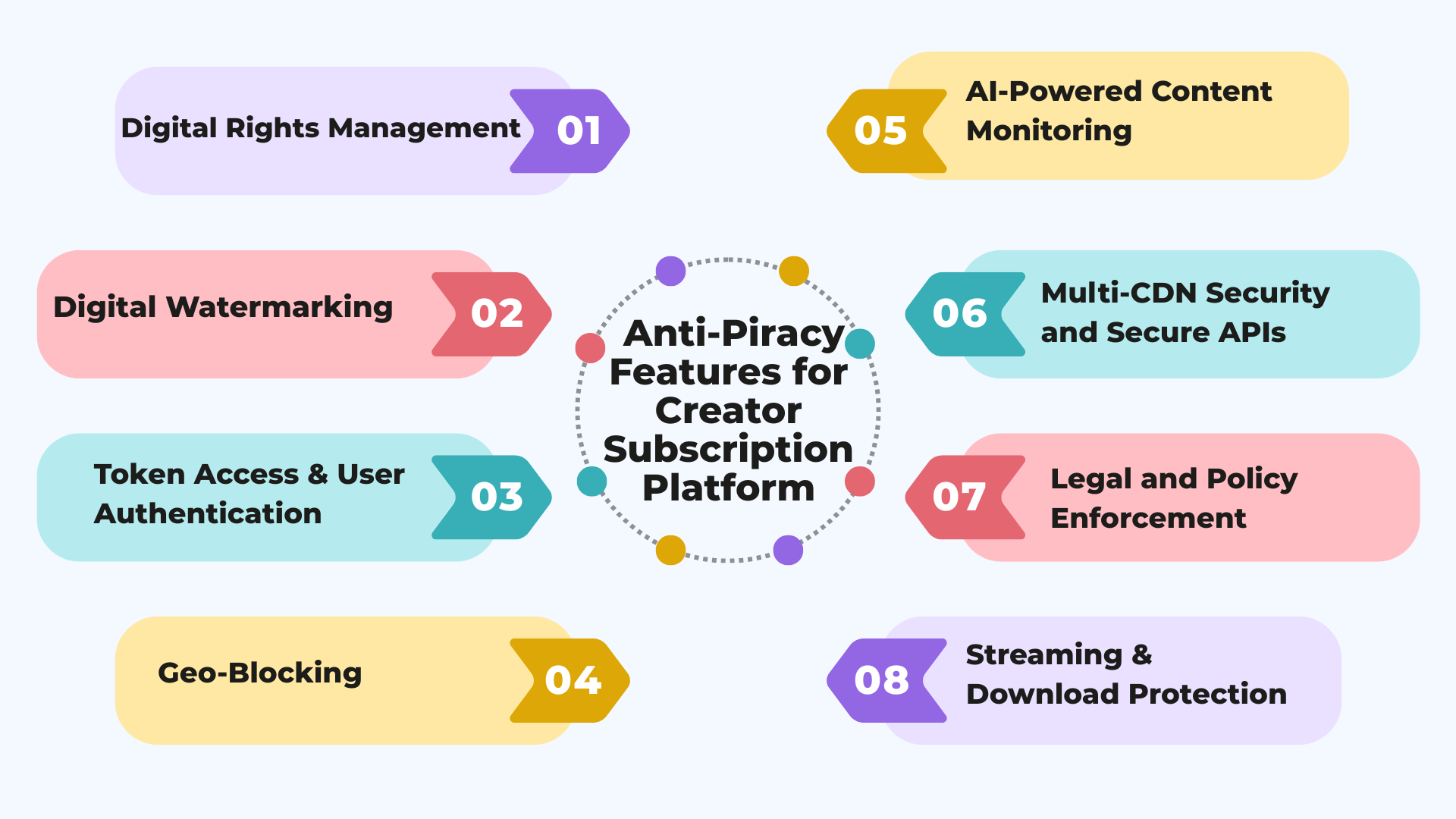
1. Digital Rights Management
Content is the creator’s masterpiece and represents their expertise, effort and creativity. Now, this is invaluable and unique to every creator and can rarely be the same. Digital Rights Management is a powerful tool to control and manage access to digital content.
DRM is a set of policies and technologies that encrypt and authorize access to videos, music, and e-books. So, when a user accesses a DRM-protected file, their license is authenticated, and once it succeeds, they can access the content.
This way, DRM protects the content from being exported and unauthorized access. Major DRM-technology systems are Google Widevine, PlayReady, and FairPlay.
DRM essentially includes the following technologies:
- Content Encryption – Media is locked, and only the right key can unlock it.
- License Control – The platform sets policies like who can watch it, specific devices and regions, and how long it can be accessed. When a user accesses the content, the license server authenticates the access rights. Next, a decryption key is provided for access.
- Customizable access control – DRM prevents direct file downloads, stopping playback, and screen recording based on defined rules.
How Does it Help?: Prevents unauthorized access, ensures regulatory compliance, and improved data security
2. Digital Watermarking
What if creators could add a unique identifier to recognize their work? Digital watermarks are essentially recognizable patterns or images to show ownership. Now, these watermarks could be either visible or invisible.
Suppose a content leak happens, platforms can easily trace the content back to its source. Besides, it also discourages creators from stealing content.
OnlyFans provides a built-in watermarking that adds the profile URL, or you can create a custom watermark. It is added to your playback in real-time as an extra layer of the creator’s content.
Two types of watermarks are:
- Visible – Include user ID, email, or profile name within the image.
- Invisible (Forensic Watermarks)- Embed hidden data within video frames, pixels, or components. Dynamic watermarks are generated based on session, user, or device.
How Does it Help?: Trace content ownership, discourage content theft, and safeguard platform content
3. Token Access & User Authentication
Multi-factor authentication and token-based access lay the foundation of modern, secure, and scalable subscription platforms.
Traditional creator platforms relied on passwords and servers. However, drawbacks such as remembering passwords and ease of password theft were evident. So, users had to enter their credentials each time they logged in.
Enter token-based access & authentication. With a token-based protocol, users provide their credentials and, in exchange, get an access token. This token is sent back to the user or device for authentication.
Until the token is valid, users can access the website, rather than re-entering the credentials each time.
How Does it Help?: Reduces password usage, enhanced security, and better user experience
4. Geo-Blocking
Creators value their privacy, and geo-blocking helps to block users from specific regions or even their home country. While geo-blocking isn’t a direct anti-piracy feature, it is a great preventive measure to protect from security threats.
Subscription platforms like OnlyFans support geo-blocking due to country restrictions, chargebacks, creator settings, etc. So, it’s like a blacklist of IP addresses/ users for the platform to control who views your content.
Anonymity is valued by creators of subscription platforms. For example, if a creator can block all users from the US, when someone tries to access their page, they will get an error message.
How Does it Help?: Protects the creator’s privacy, safeguards content from countries with a higher risk of security threats, and ensures regulatory compliance
5. AI-Powered Content Monitoring
Like all other spheres of the digital realm, AI has evolved as a powerful tool in fraud detection and cybersecurity. Device fingerprinting is a widely used technology to prevent suspicious activities.
So, how does it work? This technique creates unique digital fingerprints with machine learning for every piece of content. Unique features of the content are used to create the fingerprint and later stored in the database.
Now, the algorithm continuously scans the internet for plagiarized content that matches the stored fingerprint and sends takedown notices when a match is found. This reduces the manual work of scanning through enormous amounts of internet sources and detects even altered content.
How Does it Help?: Identify plagiarized content, reduce the tedious work of scanning across multiple internet sources, and take timely action
6. Multi-CDN Security and Secure APIs
Imagine someone from London accessing your US-based website. Now, there are two ways to retrieve the website: access from the origin server (which is time-consuming), or access from a local UK PoP (much quicker). That’s what a CDN does in a nutshell!
Along with seamless content delivery, security is a priority for CDNs. Now, to avoid interception of data or content leaks during transmission, CDNs employ unique security mechanisms. SSL/TLS data encryption, protection from DDoS attacks, CDN geo-blocking, and token-based access are its security benefits.
API threats are one of the key causes of cybersecurity attacks. In subscription platforms, APIs streamline subscriptions, analytics, paywalls, emails, and streaming. So, you can’t afford to ignore protecting your API endpoints.
Here’s how platforms can secure API endpoints:
- Implement API gateways to validate tokens, logging in, and IP-blocking
- Use the central OAuth Server for issuing tokens.
- Combine multiple authentication methods (OAuth, API keys)
- Limit requests for a single IP
How Does it Help?: Avoids content leaks during transmission, encrypts data, token-based access, and secure APIs act as a single authentication point.
7. Legal and Policy Enforcement
While the subscription platforms secure creators financially, many platforms often ignore the legal side. For protecting intellectual property rights, it’s crucial to avoid copyright infringement.
And creators offering exclusive content are at risk of such malpractices from other creators or subscribers. That’s when the Digital Millennium Copyright Act (DMCA) takedown service safeguards platform content and keeps a steady revenue for creators.
Here are the key elements of the comprehensive DMCA process:
- Register a DMCA agent with an email address.
- Include transparent anti-piracy laws in the platform’s terms and services policy
- Proactive scanning of your platform and other popular websites on the internet for identifying any cases of infringement
- Establish a clear DMCA takedown notice process and form with key details
- Submit the takedown notice on time to the concerned service provider
- Monitor the response and follow-up
How Does it Help?: Protects from copyright infringement and establishes a clear process for remedial action
⚡Related:
8. Streaming & Download Protection
Content is one of the most valuable assets for creators. That said, screen recording is one of the common ways content gets leaked on subscription platforms. Result? Loss of revenue, easy access to infringing content, and reputation damage.
Here are different ways to stop screen recording:
- DRM for videos
- Digital watermarking to prove ownership
- Use HTML5 video player and secure video delivery platforms
- Disable right-click and download options
- OS-level protection, such as Android flag_secure and iOS screen recording
- Password-protection for files like PDFs and e-books
Combine these strong protection mechanisms to prevent unauthorized content access and piracy.
How Does it Help?: Prevents content infringement, protects downloads, and disables screen captures
Fanso.io’s Anti-Piracy Features Built for Creator Protection
Fanso.io is built on the best-in-class tech stack that prioritizes security, scalability, and monetization potential. The clone script has been tested for all kinds of security threats. Fanso offers unmatched security across all scenarios.
From implementing SSL and HTTPS protocols and role-based access control to geo-blocking and PCI-DSS compliance, it adopts a security-first approach. Businesses can focus on scaling and monetizing from the platform, while Fanso safeguards you from external security threats.
It is robust enough to handle huge traffic spikes, thousands of livestreams simultaneously and offer a seamless and secure content delivery. To embrace the creator economy with confidence and safeguard your platform data, contact our team today!
Conclusion
In the subscription landscape, the importance of security cannot be overstated. A combination of advanced technology and the right anti-piracy security measures helps to safeguard your platform content.
Along with security measures, it’s crucial to educate creators and users on how to protect their privacy and data on creator platforms. Robust solutions built on modern technology and adopting a proactive approach assure the long-term success for creators and the platform as a whole!
FAQ-Related to Anti-Piracy Features for Creator Subscription Platform
1. How does piracy affect creators?
Content piracy causes financial loss, damages brand reputation, leads to emotional distress, and legal consequences for creators.
2. What is anti-piracy protection in creator platforms?
DRM, digital watermarking, token access & authentication, geo-blocking, legal and policy enforcement and Multi-CDN and secure APIs are anti-piracy protection measures.
3. How does DRM protect against piracy?
DRM safeguards content with encryption, license control and access rights protecting from unauthorized access.
4. Can anti-privacy tools prevent screen recording?
Operating system-level restrictions, digital watermarking, DRM, and advanced protection in the HTML5 video player prevent screen recording.